Prime Minister Mark Carney's inaugural federal budget demonstrates a concerning lack of preparedness for tackling Canada's severe housing crisis, according to analysis. The proposed measures appear half-hearted and fail to adequately address the regulatory constraints throttling new construction across the nation.
Canada's Massive Housing Shortage
Canada has chronically underbuilt housing relative to burgeoning demand, resulting in a national shortage of approximately 2.6 million units according to the Canada Mortgage and Housing Corporation. This supply-demand imbalance represents the primary reason why inflation-adjusted home prices have doubled since the early 2000s—simply too many Canadians are competing for scarce inventory.
The housing crisis could potentially be resolved through two approaches: decreasing demand through immigration reductions or significantly boosting housing construction. The previous Trudeau government took initial steps by cutting permanent immigration targets by over 20%—from 500,000 annually to fewer than 395,000—and reducing temporary immigration targets from 6.2% to 5% of the population.

Carney's Immigration Cuts and Market Impact
Carney's 2025 budget builds upon this momentum by further reducing temporary immigration by another 25 to 32 percent, depending on the year, as part of a stated effort to responsibly manage immigration and alleviate housing demand pressures.
This immigration slowdown has already produced measurable effects, easing rental prices nationally. However, since new immigrants typically don't purchase homes until several years after arrival, the impact on housing sales and purchase prices will likely lag behind rental market improvements.
While Carney's immigration reductions are noteworthy, analysts stress that the fundamental solution lies in boosting supply. Even if all immigration were temporarily suspended, Canada's housing construction remains sluggish, averaging roughly 250,000 housing starts annually—far below what's needed to close the massive deficit.
Build Canada Homes Initiative Falls Short
The budget's centerpiece housing program, Build Canada Homes, will receive $7.28 billion over five years primarily to construct non-market affordable housing. This averages approximately $1.46 billion annually—just half of what the Liberals pledged to spend on affordable housing during their spring election platform ($2.9 billion per annum).
According to budget documents, these funds will be used to build 45,000 units, including at least 4,000 factory-built homes. Much of this development will occur on public land sites, with an additional $1 billion allocated toward transitional and supportive housing for homeless and housing-insecure Canadians.
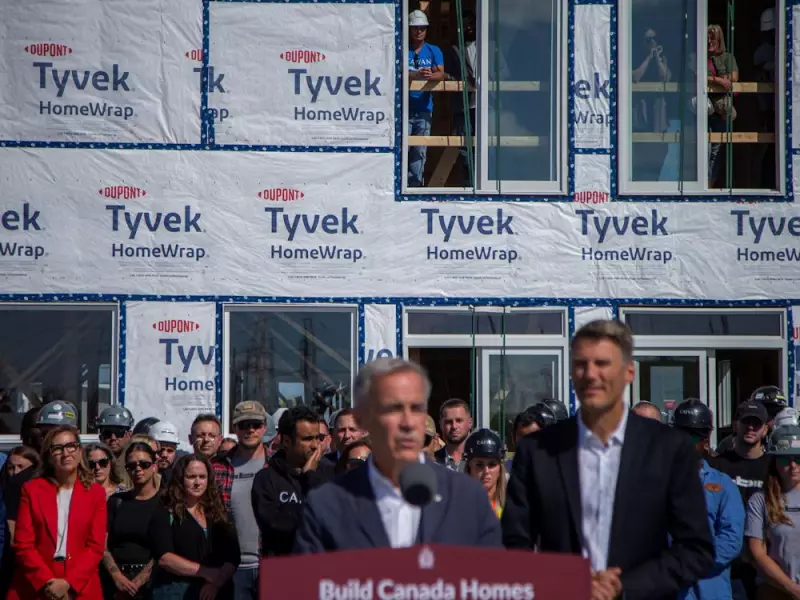
The initiative's launch featured Prime Minister Carney posing before an under-construction modular home outside Ottawa, though the home was dismantled shortly after the press conference and its components sent to a site unconnected to any Build Canada Homes project.
Previous Program Performance Raises Concerns
Historical performance of similar federal housing programs raises questions about implementation effectiveness. The Rapid Housing Initiative (RHI), for example, promised to build over 12,000 affordable housing units for $3.84 billion over four years (2020-2024).
Government data updated in June reveals that, while the program targeted 16,058 new affordable units, only 8,981 have been completed so far—demonstrating significant implementation challenges that could also affect the new initiative.
Even if Build Canada Homes successfully constructs all planned units, the overwhelming majority of Canadians will still rely on the private housing market, which this initiative does little to improve. The fundamental issues of overregulation and insufficient construction capacity remain largely unaddressed in Carney's budget, leaving serious questions about its ability to meaningfully impact Canada's housing affordability crisis.