Edmonton's Growth: A Strategic Asset Driving Economic Prosperity
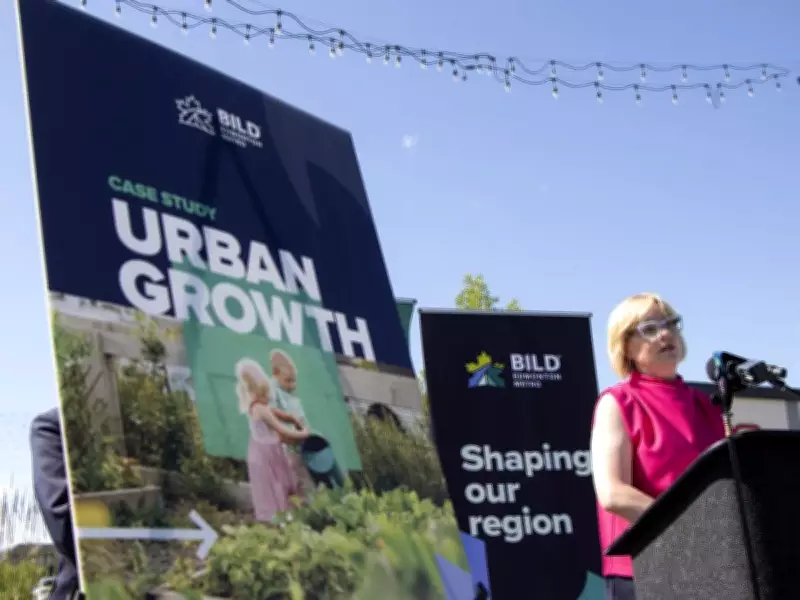
A comprehensive new study from BILD Edmonton Metro presents compelling evidence that Edmonton's population expansion represents a significant economic advantage rather than a municipal burden. The Urban Growth Case Study, launched at the Currents of Windermere in Edmonton on Tuesday, July 15, 2025, offers a data-driven examination of how urban development impacts the city's economy, infrastructure systems, and community dynamics.
Challenging the Growth Narrative
Lindsey Butterfield, Vice President of Government Relations & Policy at BILD Edmonton Metro, expressed concern about recent city council discussions framing population growth as the primary driver behind rising municipal taxes and operational challenges like snow-clearing services. "That narrative may be convenient, but it is not accurate," Butterfield emphasized. "It is not grounded in data and evidence, and it risks undermining one of Edmonton's greatest competitive advantages at a time when cities across Canada are fighting to attract people, talent, and investment."
As a lifelong Edmontonian with decades of experience in city building, Butterfield argues that growth represents proof of success rather than a problem requiring containment. The data supports this perspective: in 2025, Alberta recorded historic housing start numbers, with more than 20,000 homes constructed within the Edmonton metropolitan region alone.

The Realities of Modern Development
Contrary to outdated perceptions of urban sprawl, contemporary Edmonton neighborhoods demonstrate sophisticated planning principles:
- Increased density compared to historical developments
- Greater housing diversity responding to market demands
- Compact community design that supports walkability
- Alignment with modern policy priorities for sustainable development
These communities represent places where families establish roots, children walk to educational institutions, neighbors build relationships, and social connections flourish—much like established neighborhoods such as Westmount in the 1920s, Ottewell in the 1960s, Brander Gardens in the 1990s, or Summerside in the 2020s.
Financial Implications and Strategic Positioning
The economic argument for controlled expansion receives validation from municipal analysis. A recent City of Edmonton examination of the newly approved Kendal neighborhood in the city's southwest revealed that its planned density will position the municipality favorably financially over the long term. This finding aligns with broader evidence that strategic growth supports rather than strains municipal resources.
"Growth is not our problem. Growth is our proof of success," Butterfield asserted. "People are choosing Edmonton deliberately and enthusiastically because it offers opportunity, affordability, employment, and a quality of life that remains within reach for families, new Canadians, and young professionals alike. Cities do not stumble into that position."
Edmonton has cultivated this advantageous position through decades of intentional planning, thoughtful policy development, and maintaining a reputation for welcoming ambition and innovation. The city has consistently demonstrated an openness to new ideas and new residents—a characteristic that distinguishes it from municipalities that adopt more restrictive approaches.
The True Risk: Stagnation Rather Than Expansion
The study identifies urban stagnation or, worse, population decline as the genuine liability facing modern municipalities. Recent discussions at Edmonton City Hall regarding new neighborhood development suggested this fundamental reality might be overlooked in current policy debates.
Casting doubt on growth—particularly after approving comprehensive long-range plans, infrastructure strategies, and land-use policies explicitly designed to support expansion—creates uncertainty that carries tangible costs. This uncertainty can weaken investor confidence, slow housing delivery timelines, and ultimately make affordability more challenging to achieve for the very residents municipal governments are tasked with serving.

The Urban Growth Case Study presents Edmonton with an opportunity to reframe its growth conversation from one of problem-solving to one of strategic advantage. As Canadian cities increasingly compete for talent, investment, and innovation, Edmonton's expansion represents not a challenge to manage but an asset to leverage for continued prosperity and community development.