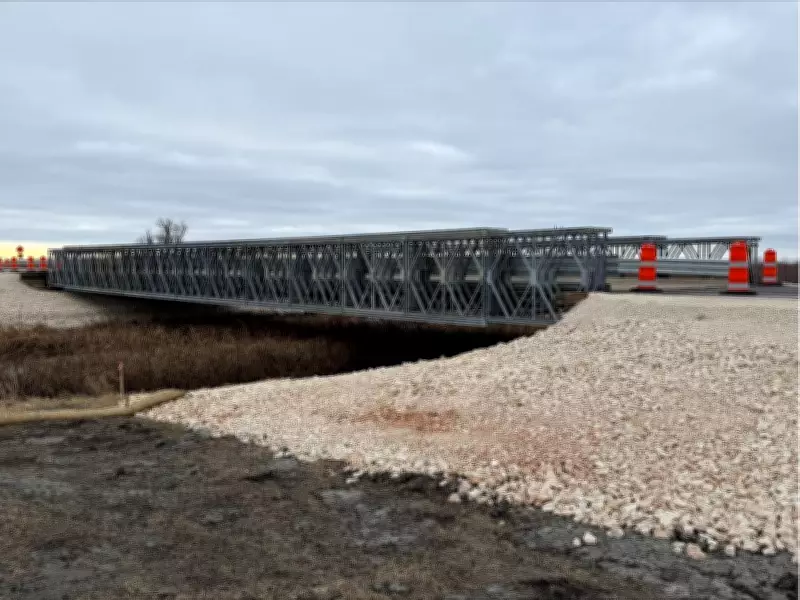
Acrow, a prominent international bridge engineering and supply firm, has announced the installation of one of its modular steel bridges on Manitoba's Provincial Trunk Highway 3 (PTH 3) near the community of Brunkild, southwest of Winnipeg. This rapid deployment was executed by Manitoba Transportation and Infrastructure (MTI) to address an emergency closure caused by geotechnical instability at a bridge crossing the Morris River.
Addressing Community Concerns with a Swift Solution
Initially, a detour route redirected highway traffic onto smaller residential roads, specifically PTH 13 and PTH 2. Residents expressed significant concerns, noting that these roadways were not designed to handle heavy traffic volumes and could suffer damage. MTI's proactive approach involved utilizing its inventory of Acrow modular bridging components, enabling a quick response to these issues.
Technical Specifications and Installation Details
The Acrow 700XS® bridge, installed by MTI's team and opened to traffic on November 8, 2025, features a length of 39.62 meters (130 feet) and a roadway width of 7.35 meters (24 feet). It was installed using a crane-assisted launch and finished with an epoxy aggregate deck. This temporary structure is expected to remain in service until late 2026, when the permanent bridge over the Morris River is slated for completion.

Leadership and Resilience in Infrastructure Planning
Oliver Radack, Director of Business Development and Operations at Acrow Canada, commended MTI for its leadership in ensuring traveler and community safety. He highlighted MTI's swift actions, from inspecting and closing the bridge to adjusting the detour plan and deploying the Acrow solution. Russ Parisi, Acrow's Vice President North America, emphasized the importance of resilience planning, noting that having bridge assets on hand allows for versatile and quick adaptations to project needs, with easy disassembly and reuse for future applications.
Acrow, with over 70 years of experience, provides modular steel bridging solutions for permanent, temporary, military, and emergency uses across more than 150 countries. This installation underscores the value of prepared infrastructure strategies in maintaining critical transportation routes during disruptions.