Middle East Conflict Sparks Global Air Travel Chaos, Stranding Thousands
The most significant disruption to global air transport since the COVID-19 pandemic continued for a second day on Sunday, as escalating Middle East tensions forced widespread flight cancellations and delays, leaving thousands of passengers stranded at airports worldwide.
Massive Flight Cancellations and Delays Reported
Flight tracking website FlightAware reported that more than 2,700 flights had been cancelled globally and over 12,300 delayed as of Sunday afternoon. Aviation analytics firm Cirium provided additional context, revealing that more than 1,500 flights to the Middle East were cancelled on Sunday alone, representing over 40 percent of scheduled traffic to the region.
Major Gulf Airports Shuttered Amid Regional Tensions
The disruption stems from retaliatory strikes launched by Iran against Gulf cities, including direct hits on Dubai International Airport—the world's busiest for international traffic—and Kuwait's main airport. In response, multiple countries including Iran, Iraq, Israel, Syria, Kuwait, Qatar, and the United Arab Emirates announced at least partial closures of their airspace.

"There haven't been any other crises of this magnitude since Covid," said Didier Brechemier, an expert at business consultancy Roland Berger, in an interview with AFP. He noted that even Russia's invasion of Ukraine did not affect the major Middle Eastern air hubs that serve as critical transit points for travelers to destinations throughout Asia.
Passengers Stranded Worldwide as Airlines Scramble
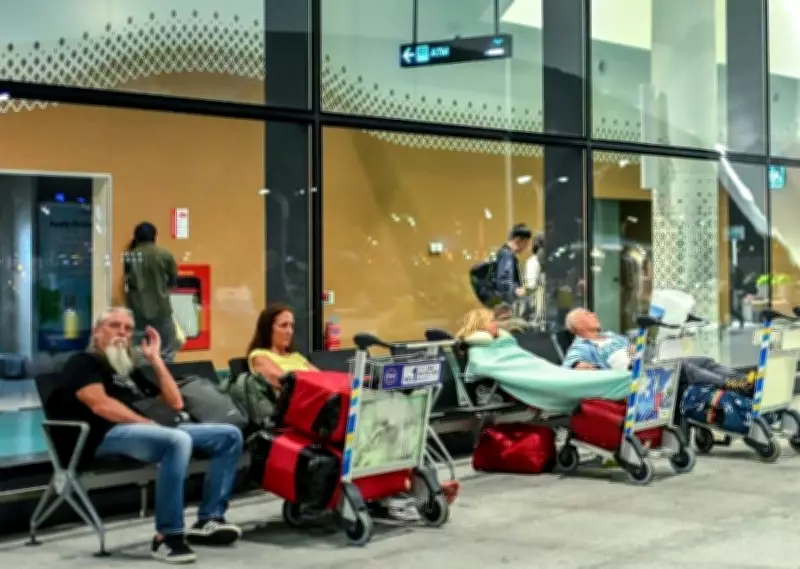
Passengers found themselves stranded across the globe as airlines attempted to reroute flights around the closed Middle Eastern airspace. The situation created scenes of frustration and uncertainty at airports from Male in the Maldives to Mumbai, where India's two largest private carriers, IndiGo and Air India, suspended flights to all Middle Eastern destinations.
For some travelers, the disruption extended beyond mere inconvenience. Italian rapper BigMama described a harrowing experience on Instagram, posting a tearful video explaining that her flight from Male had been rerouted to a desert location near Dubai. "We keep hearing missiles over our heads. I'm terrified," she wrote. "We didn't sleep a wink all night. We still have no news. We just want to go home."
Economic Impact and Passenger Experiences
The financial consequences are already substantial. "The costs are already amounting to hundreds of millions of euros in losses for air transport," said Didier Arino, CEO of consulting firm Protourisme.
Passengers shared diverse experiences of the disruption. A traveler stuck at Johannesburg's main international airport after his Emirates flight to London was cancelled told local SABC News: "I have got work tomorrow so, if my manager is watching: Johnny, I will be back later this week, hopefully." He added that when attempting to book alternative tickets, "the prices are going up every 10 minutes, 20 minutes."
Another passenger in Cape Town, identified only as Farhad, was trying to return to Germany after a holiday. "I don't know where I am sleeping tonight," he told Newzroom Afrika broadcaster, adding philosophically: "The whole world is connecting, and something that happened 10,000 kilometres away is also in Cape Town or Germany or wherever."
The global air travel network remains severely disrupted as airlines and aviation authorities work to establish alternative routes and manage the fallout from the Middle East conflict's impact on international airspace.