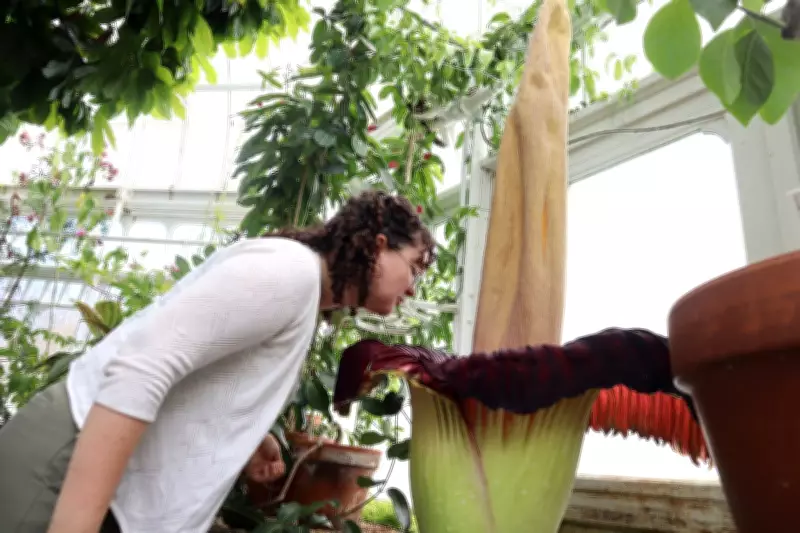
Mount Holyoke's Corpse Flower 'Pangy' Blooms Again, Drawing Crowds with Its Infamous Stench
Mount Holyoke College's Talcott Greenhouse in South Hadley, Massachusetts, has become a hub of activity as its corpse flower, affectionately named "Pangy," has bloomed once more. This rare botanical event, occurring on Tuesday, April 14, 2026, is captivating visitors who flock to experience the plant's notorious odor, often described as resembling rotting flesh.
A Unique Botanical Attraction
The corpse flower, scientifically known as Amorphophallus titanum, is native to the rainforests of Sumatra and is celebrated for its massive size and pungent smell. At Mount Holyoke, Pangy's bloom is a significant occurrence, drawing students, faculty, and the public to the greenhouse. Caroline Murray, a senior at the college, was among those who leaned in to smell the flower, highlighting the communal curiosity it inspires.
This bloom marks another chapter in Pangy's history at the institution, where it serves as both an educational tool and a natural wonder. The plant's lifecycle is unpredictable, with blooms happening infrequently and lasting only a few days, making each event a must-see spectacle.

The Science Behind the Smell
The foul odor emitted by the corpse flower is a survival mechanism designed to attract pollinators such as carrion beetles and flesh flies. By mimicking the scent of decaying animals, the plant ensures its reproduction in the wild. At Mount Holyoke, this biological adaptation provides a hands-on learning opportunity for botany and environmental science students.
Greenhouse staff monitor Pangy closely, noting that the bloom's timing can vary based on environmental conditions like temperature and humidity. This recent flowering underscores the college's commitment to preserving and studying rare plant species, contributing to broader conservation efforts.
Community Engagement and Educational Impact
The bloom has sparked widespread interest, with social media buzz and local news coverage amplifying its reach. Visitors to the Talcott Greenhouse often share their experiences, describing the smell as both off-putting and fascinating. This engagement fosters a deeper appreciation for biodiversity and the peculiarities of the natural world.
Mount Holyoke College leverages such events to promote STEM education, encouraging young people to explore careers in science. The corpse flower's bloom serves as a reminder of nature's wonders and the importance of protecting endangered species in an era of climate change.
As Pangy's petals begin to wilt, the memory of this fleeting bloom will linger, much like its scent, inspiring awe and curiosity for years to come.