Stephen Harper's Official Portrait Contains Intricate Personal Details and Hidden Meanings
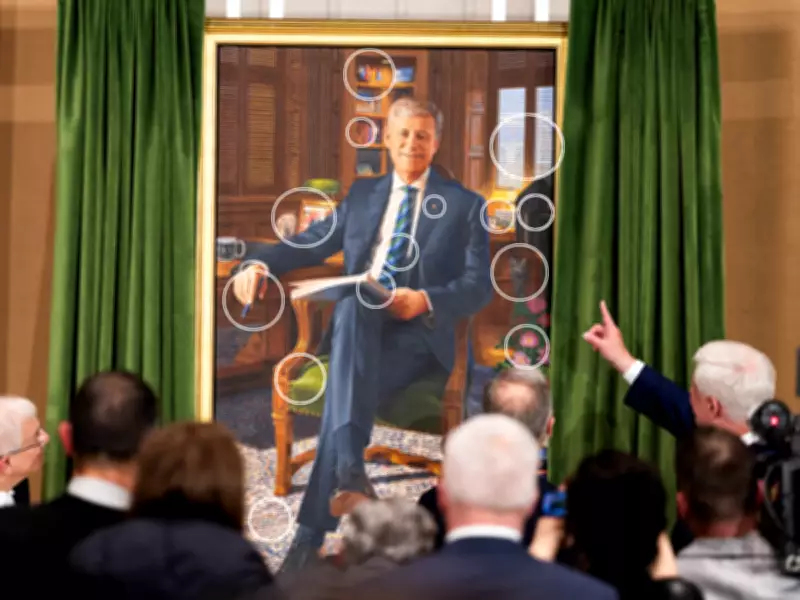
The recent unveiling of former Prime Minister Stephen Harper's official portrait in Ottawa has revealed a fascinating collaboration between artist Phil Richards and his subject. Richards, who views portraiture as a joint creative effort, incorporated numerous personal symbols and Easter eggs that tell Harper's story through visual elements.
A Flag Expert's Precision Correction
Among the most intriguing aspects of the portrait is a tiny but significant correction made at Harper's suggestion. The artwork features a collection of flags at the top, including one from New Brunswick representing Harper's ancestral home. Richards initially painted a red banner on the ship within the flag flying backward, assuming it would trail behind like a flag from a moving vehicle.
"If you're driving a car and you hold a flag out the window, then the flag is going to be pointing behind you, because you're moving forward," Richards explained to National Post. "So I made the assumption subconsciously that this banner would be pointing back, in the opposite direction the ship is moving in."

Harper, an amateur vexillologist and author of Flags of Canada, noticed the error when Richards sent him preview images before finalization. "He said, 'You know, I hate to say it, but there's a mistake in the flag of New Brunswick,'" Richards recalled. The artist promptly corrected the banner to show it flowing in the same direction as the wind pushing the ship forward.
Personal Symbols and Family Tributes
The portrait is rich with personal references that provide insight into Harper's life and career:
- Stanley the Cat: A grey tabby adopted by the Harpers from the Ottawa Humane Society in 2011 appears in the portrait. Named through a national contest with a nod to the Stanley Cup, the 15-year-old cat is depicted in his younger days due to current health concerns. During the unveiling ceremony, Harper humorously noted that Stanley "consistently polled better than I."
- Flag Collection: Beyond New Brunswick's flag, the bookshelf displays flags representing Alberta (Harper's adult home), Ontario (his childhood home), and Kainai First Nation of Alberta, where he holds honorary chief status. Harper also wears his signature Canada flag pin that became a trademark during his time in office.
- Family Photographs: Multiple personal photos appear throughout the composition, including images of Alert, Nunavut (visited in 2006), Quebec City (Calgary's sister city), a deer from Harper's Bragg Creek property, childhood family photos from Leaside (now Toronto), and family moments at 24 Sussex Drive.
- Literary References: The bookshelf contains meaningful volumes including a French dictionary (reflecting Harper's bilingualism), Adam Smith's The Wealth of Nations (acknowledging his economics background), James Buchanan's Democracy in Deficit, Preston Manning's The New Canada, Harper's father's book Old Colours Never Die, a Bible, and bound copies of trade agreements from Harper's government.
The Collaborative Artistic Process
Richards emphasized that this portrait represents a true partnership between artist and subject. The inclusion of so many personal elements required extensive consultation and shared decision-making. Harper's attention to detail extended beyond the flag correction to ensuring accurate representation of various symbolic items throughout the composition.
The portrait also includes subtle artistic touches, such as a sketch of a trillium signed by Richards and a cribbage board among the desk items. These elements combine to create a multidimensional representation that goes beyond traditional political portraiture.
The unveiling ceremony in Ottawa on February 3, 2026, highlighted how official portraits can serve as historical documents that capture both public service and personal identity. Through careful collaboration, Richards and Harper have created an artwork that will offer future generations insights into both the man and his time in Canadian political leadership.