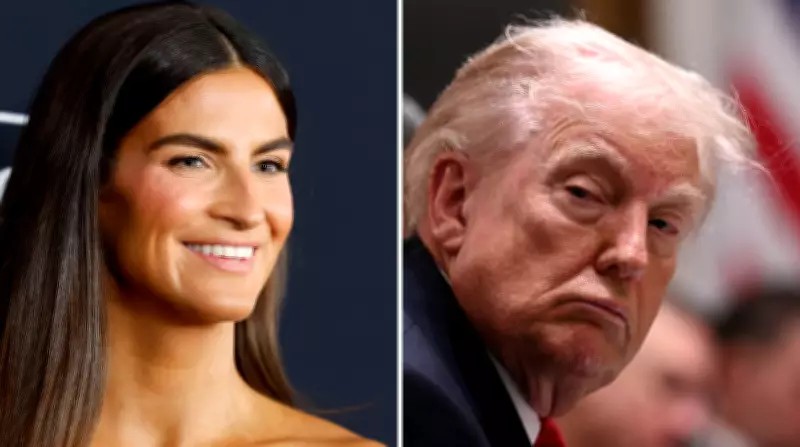
Decoding the Nonverbal Battle: How a Journalist Maintained Composure Under Presidential Fire
The recent heated exchange between CNN White House correspondent Kaitlan Collins and former President Donald Trump has captured national attention, with Trump criticizing Collins' demeanor after she questioned him about justice for Jeffrey Epstein's victims. While much focus has been on Trump's conduct, a deeper analysis reveals something remarkable happening on Collins' side of the interaction.
According to body language expert Patti Wood, author of "SNAP: Making the Most of First Impressions, Body Language, and Charisma," Collins demonstrated textbook techniques for navigating unavoidable adversarial conversations. Her nonverbal communication offers valuable lessons for anyone facing hostile confrontations.
The Power of Posture: Standing Your Ground with Strength
Wood immediately noticed Collins' exceptional posture during the exchange. "She showed some great indications of strength," Wood observed. "If you look at her posture, it was very straight — up and down. She didn't lean back. She didn't lean forward. I call it 'standing in place' or 'standing in strength.'"

This aligns with scientific research about posture's psychological effects. A study published in Psychological Science found that expansive postures with widespread limbs and occupying more space can increase feelings of power and risk appetite compared to closed, constricted positions.
Wood, who regularly analyzes press conferences and official briefings, noted that such strength isn't always present. "I see sometimes they're leaning forward or they're kind of hiding themselves with their pad, there's a lot of things I see that show fear," she said. "She's not showing that [fear]."
Vocal Control: Maintaining Steadiness Under Pressure
In situations where someone becomes belligerent, maintaining vocal composure represents a significant challenge. Many people experience accelerated speech, nervous stumbling, noticeable tone shifts, or even tears of frustration.
Collins demonstrated remarkable vocal control throughout the exchange. "Overall, there was strength in her voice," Wood analyzed. "No matter what he said, there was strength. She was stating questions, she sped up a little bit, she had a question mark at the end. But, other than that, she didn't show signs of fear."
Even while being berated, Collins maintained vocal consistency. "She didn't raise her voice. She didn't lower her voice," Wood noted. "She didn't speak with pauses and caution, she just kept going — and it was quite an onslaught from him."
Strategic Gesturing: Calming Without Matching Anger
Wood identified a particularly interesting detail in Collins' gesturing. Despite facing what she described as an "onslaught," Collins didn't mirror Trump's aggressive tone or attitude.
"Her first gesture, as she begins to speak, is a sort of sweep downward toward him," Wood explained. "I believe it's intuitively, she's trying to settle him down with her hand. Then the next gesture is sort of a sweeping backward gesture. Both of those gestures are very strong. They were out, away from her body, slightly above her waist — and typically above the waist are gestures of strength."
These movements were smooth and coordinated with her speech, indicating control rather than emotional dysregulation.
Allowing Others to Reveal Themselves
Wood contextualized the exchange within broader patterns of presidential conduct, noting that Trump has significantly shifted expectations of professionalism in presidential settings. "What we often see in situations like this — right down to the decision to be sitting at the desk in the Oval Office flanked by his team — is just 'not normal,'" she observed.
The expert suggested there's value in allowing people to demonstrate their own behavioral patterns. In this case, Trump's response to questions about Epstein victims and his insistence that Americans "move on" revealed significant information.
"He's saying his standard lines, but in his voice, it's clear he's losing his power — and that's when he made the move to attack her," Wood analyzed. "His pattern is to attack when he feels like he's losing power."

Wood found particularly unsettling Trump's apparent search for validation during the attack. "The weird thing is he's looking for the other people to join in," she said. "And that is particularly unsettling for us. I'm sure for any woman that's ever been verbally or physically attacked by a man, it just triggers that feeling of 'ugh.'"
Collins' composed response, according to Wood's analysis, provides a powerful template for maintaining dignity and strength when facing aggressive communication, offering practical strategies that extend far beyond political journalism into everyday challenging conversations.