Bridgerton Season 4's Pivotal Staircase Scene Sparks Debate on Romance vs. Reality
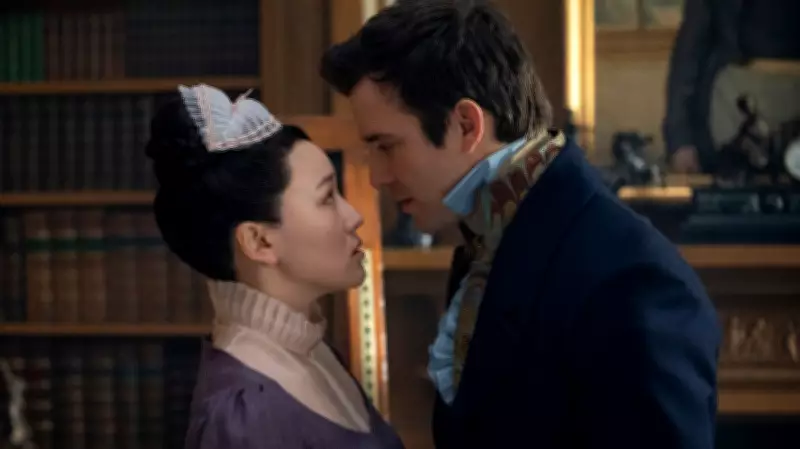
The meticulously constructed worlds of aristocracy and service in Netflix's Bridgerton collide with dramatic force in the closing moments of Season 4's first half. In a scene charged with tension, Benedict Bridgerton (Luke Thompson), the family's bohemian second son, shares a passionate kiss with Sophie Beck (Yerin Ha), an illegitimate maid, on the back staircase of the Bridgerton home. This moment culminates four episodes of simmering desire, seemingly signaling Benedict's full capitulation to love.
A Proposal That Cools the Passion
As an orchestral version of Olivia Rodrigo's "bad idea right?" swells, Benedict pulls back from the embrace to confess, "The truth is I stay away because you consume me." The music builds anticipation, only to fade abruptly as he poses a question Sophie expects to be a marriage proposal. Instead, he whispers a rakish request: "Sophie, be my mistress." The heat instantly dissipates. Sophie retreats downstairs to her servant's role, leaving Benedict alone in the darkness, his question hanging unanswered.
This mid-season cliffhanger deliberately echoes the post-carriage proposal from his brother Colin in Season 3, yet Benedict's offer is fundamentally different. It presents the harsh Regency-era reality: despite undeniable chemistry, a maid could never be an acceptable wife for a member of the ton. This dose of social realism underscores that Bridgerton has never been purely a fantasy romance.

Criticism and the Show's Core Identity
Following the first part's release, the series faced criticism from some viewers who feel recent seasons have evolved into "ensemble dramas" that prioritize world-building over romantic catharsis, leaving the show "stuck in the matrix" compared to straightforward romances like Heated Rivalry. However, this critique misunderstands Bridgerton's foundational premise. Creator Shonda Rhimes has consistently situated steamy romance within a broader social context that mirrors contemporary political tensions.
Romance, as Rhimes emphasizes, is always political. This theme is evident from her earlier hits like Grey's Anatomy and Scandal to the Bridgerton universe. Each season anchors on a sibling's love story, but that narrative exists within—and is complicated by—social structures and duties. Benedict and Sophie's storyline follows this exact pattern, forcing audiences to confront the era's rigid class barriers.
A Legacy of Social Commentary
Even the debut season in December 2020, which captivated lockdown audiences with bold scenes between Daphne and Simon, was never a romance removed from reality. A central conflict involved Daphne's ignorance about conception and Simon's deliberate withholding of information due to his vow against continuing his lineage. The show confronted uncomfortable truths about women's limited autonomy and sexual knowledge within aristocratic marriages.
Rhimes expanded this exploration in the spinoff Queen Charlotte, which delved deeply into the monarchy's sexual politics and how women's desires are constrained for political purposes. This foundation enriched subsequent seasons, adding depth to Anthony and Kate's enemies-to-lovers arc in Season 2 and Penelope's struggle to balance marriage with her writing ambitions in Season 3.
Season 4's Central Tension and Expanding World
The second part of Season 4 places the question of sacrifice squarely in the spotlight. While Benedict and Sophie's Cinderella-style attraction is clear, the tension revolves around whether they can accept the realities of being together. Can Sophie trust herself to live as his secluded mistress? Will Benedict truly forsake society's diversions? Crucially, how might their arrangement impact his siblings' marriage prospects or any potential children?

To explore these questions, Bridgerton weaves in relevant subplots: Violet's hesitation about committing to a new "gardener," Francesca grappling with premature loss, and non-romantic threads involving Queen Charlotte, Lady Danbury, and the younger Bridgertons. These storylines bring grief and duty to the forefront, shaping the context for Benedict and Sophie's decisions.
The Challenge of Balancing Romance and Narrative Scope
However, these expanding subplots highlight a risk inherent in Rhimes' storytelling. As the show progresses and the world grows, there is less narrative space for the central romantic arc that traditionally anchors each season. For viewers seeking the vicarious spark of irresistible attraction, numerous subplots can dampen that fire. The series now faces a critical test: can it maintain equilibrium between its romantic roots and its uniquely constructed universe?
How long will audiences grant the show grace to find this balance, especially as some crave the intense heat of series like Heated Rivalry? Only future seasons will tell. One certainty is that Bridgerton will return for a fifth season to continue testing these boundaries. For now, the entirety of Season 4, with all its romantic complexity and social commentary, is available for streaming on Netflix.