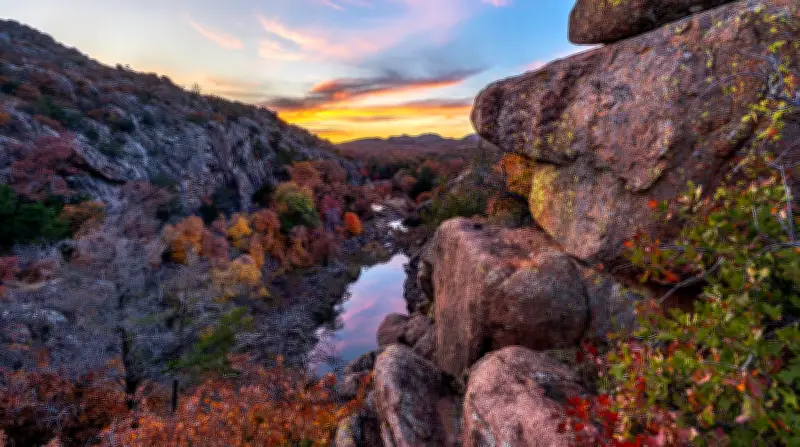
The last place I expected to find one of the oldest mountain ranges in the United States, or its first national wildlife refuge, was in Southwestern Oklahoma. Rising out of the prairie like spines on an alligator cresting the still surface of a backwater bayou, the Wichita Mountains are an oasis of craggy peaks and shimmering lakes harboring some of America’s most iconic wildlife. There, one can find majestic herds of bison and elk grazing golden native grasslands, iridescent turkey feathers and snow-white deer tails flickering among quiet forests, crystalline streams under crimson canyon walls to cast a line into, and mountaintop pools home to flora and fauna found nowhere else on the planet — just to name a few of its wild wonders.
What a surprise it was to encounter this ancient, otherworldly mountain range making its home on the smooth Southern Plains of North America, only an hour away from my own home in Chickasha, Oklahoma. I was inspired to move to Chickasha three years ago to be closer to my daughter, River, who’d moved to Oklahoma herself to work for our tribe, the Caddo Nation.
Whitetail deer are one of the most common animals found in the refuge. Many animals there take shelter in the "Cross Timbers", which is an ecological region of forest vegetation consisting mostly of post oak and blackjack that spans from Kansas through Oklahoma and into Texas, and serves as an essential element of the Southern Plains ecology.

Neither of us grew up in Oklahoma, where my Caddo/Delaware father was born. Rather, we were born near another ancient mountain range in Northeastern Oregon, called the Wallowa Mountains. They are home to another Indigenous people, Chief Joseph’s band of Nez Perce, who were infamously forced out by a cruel war of settler expansion. My father chose to name me Joseph out of respect for that history and people, and I grew up to love and respect them and their beautiful, wild homeland. My love for the land eventually led me to serve as a backcountry wilderness ranger for the U.S. Forest Service there. As I learned more about my own and other Indigenous cultures, I came to understand that it’s our sacred connection with nature and the ecologies that support us that allowed our peoples to thrive for so many countless millennia on this continent. And I came to depend on that connection as an essential part of my identity and well-being.
The Wichita tribal creation story describes their people as having emerged from Mt. Scott after a great flood. “That story is not just about a single moment in time,” says Wichita historic preservation director, Robin Williams. “It is about emergence and becoming.”
I never imagined moving to Southwestern Oklahoma before the moment I decided to. Based on my infrequent visits for family and tribal events, I viewed the seemingly monotonous terrain there as uninviting, and considered it to be a place where the most connection one could find with nature would be in a farmer’s field. Both of our tribes were ethnically cleansed from our original homelands in the Eastern and Southeastern woodlands, and sent to live within a very different ecology than the ones that formed our Indigenous identities. Oklahoma was a landscape I felt forced to connect with by circumstance, rather than a desire to. That was, until the fateful day I was talking on the phone with River, and she said, “Dad, you should move here, too.” Before the words were out of her mouth, I knew that I was going to do it. It wasn’t simply to be closer to my only child (and hopefully grandchildren someday), but because I knew that our tribal communities need our people in them, learning, and helping preserve our culture, history and traditions. Part of the deal I made with myself when I decided to give up access to the wild spaces I love to be close to my tribes and daughter, was that I would return to Oregon every summer to work at my seasonal wilderness ranger job, and get caught up on my ‘wilderness medicine’ then. So I figured it would all balance out.

The Wichita Mountains are one of the oldest and most geologically unique mountain ranges on the continent. They were formed by a failed continental rift called the Southern Oklahoma Aulacogen, and have an incredibly ancient exposed core that solidified over 500 million years ago. Today, none of their peaks top 2,500 feet in elevation; 300 million years ago, they may have reached 20,000 feet.
That balance worked well at first, and I enjoyed being able to slip into hibernation mode in a milder climate during winter ― until the wilderness ranger program was defunded, and I lost my job to politics after 12 years of service to the land.
Last summer was my first in over a decade not serving as a (real) ranger. Through a grant from the Oregon Community Foundation, I was able to go back and serve as a volunteer ranger however, because the land needs care whether the government will pay for it or not. But returning home to Oklahoma after that ― with no guarantee I’d be able to do it again ― I was forced to face the idea that I could lose all access to the wild spaces essential to my well-being.
That awareness, combined with the trajectory of the nation and its beleaguered ecologies, economic stress and anxiety about the state of the world, left me in a dark place last fall. And I was feeling like I’d find little respite in the arms of nature now that I was cut off from the wilderness locations I’d depended on for so long. Then one day I remembered that the Wichita Mountains National Wildlife Refuge lies only an hour away from me.
I first learned that the refuge played a major role in preserving America’s natural heritage while watching a Ken Burns documentary about the history of the American bison. When I heard it mentioned, my ears perked up, and I remembered my cousin telling me that I needed to visit the place. I was astounded to learn that not only is it the oldest National Wildlife Refuge in the United States, but it was instrumental in saving American bison from extinction.
The first bison the government reintroduced to the wild were sent to the Wichitas by train from the Bronx Zoo. Ironically, my Delaware (Lenape) people are Indigenous to what is now New York City, but like the buffalo, we were sent halfway across the continent to Oklahoma to keep from going extinct. I like to think the Spirits of my Ancestors played a role in preserving them from extinction in our homeland, so they could return to the prairies they belong with.
I was also surprised to learn of the role Indigenous People played in preserving bison in the refuge. It was created within the homelands of the Wichita Tribe, which later became part of the Anadarko Indian Agency jurisdiction for Kiowa, Comanche, Apache, Wichita, Caddo and Delaware people, each having their own regions of the jurisdiction. Located nearby to facilitate the U.S./ Indian wars on the Southern Plains and the forced relocation of the aforementioned tribes to their reservation lands, lies Fort Sill ― where the legendary Apache war leader Geronimo was imprisoned. It’s now home to the U.S. Army’s premier field artillery training range. As part of the United States’ wars of attrition against Native Americans in the West, they undertook the wholesale slaughter of the American bison — a primary food source for the tribes of the Great Plains and Rocky Mountain West. By the time the refuge was created in 1901, bison had become functionally extinct in the wild.
While meeting Teddy Roosevelt in Washington, D.C., Comanche chief Quanah Parker — a former enemy of the United States and the last Comanche war leader to move to the reservation — convinced Roosevelt (known for his racist attitude toward Native Americans) to visit the Wichita Mountains for a hunting trip. The president stayed at Parker’s house and slept outdoors on his veranda, and toured and hunted the mountains with him. After the visit, Roosevelt decided to create a wildlife preserve there “for the protection of game animals and birds and shall be recognized as a breeding place thereof.” In addition, he facilitated the return of 15 bison to the refuge. It was the first federal effort to reintroduce them to their homelands and save them from extinction in the wild.
One finds many unexpected but fitting juxtapositions in the Wichita Mountains National Wildlife Refuge. Elk are another species that were reintroduced to the park to replace populations that had been hunted to extinction there, and are thriving there today much like the bison.
The bison traveled by train halfway across the continent from the Bronx Zoo, where some of the last purebred members of the species were kept. Parker and other Native people were present when they first stepped foot back into the prairie grasslands where they belong, and it said he cried at the sight of it. The imposing presence of those bison in the refuge now became startlingly clear to me upon entering it for the first time. As I drove around a bend, I saw a massive bull towering over my car just off the road, free and unrestrained to roam where he pleased. I could’ve sworn I’d driven around the corner into Yellowstone, not the little-known Oklahoma wildlife refuge just down the road from me. Soon I discovered that four of the most important animals in Native American history reside in the refuge: buffalo, elk, deer and turkeys — all central to Native American identity and sustenance. In fact, many of the native species originally present on that land have been returned, or remained there.
It’s not just animal species thriving there: Expansive swaths of native grasslands and timberland fill the refuge as well, and there’s even two kinds of plants and a type of fairy shrimp who make their homes in this region and nowhere else. Topping all of that off, the Wichitas contain some of the most unique geology on the continent.
A dry vernal pool and unique boulder decorate the summit of Elk Mountain. "I think what makes the refuge so unique is the landscape," says refuge lead biologist, Dan McDonald. "It’s kind of an untouched island in an otherwise very altered landscape. We have tremendous species diversity in both the plant and wildlife species."
Moving from the unbelievably picturesque and dramatic landscape of Northeastern Oregon to the endless horizons of Southwestern Oklahoma is teaching me that every wonder of the world is equally wondrous. It’s just a matter of learning to see them for their true beauty and worth.
Who’s to say that a mere handful of the red earth nourishing the Oklahoma prairie isn’t equal in beauty to the tallest mountain on the planet? Certainly there are species native to that earth who can’t see it any other way. I am realizing the peaks are pointing back to the unassuming prairies below them, and learning to see what they want me to see there.
Who better to help me understand the deep lessons this landscape has to teach than the Wichita People, who’ve been here the longest? So I asked my friend Robin Williams (Wichita/Caddo/Comanche), who is the Historic Preservation Administrator for the Wichita and Affiliated Tribes, if she would share her people’s history with the Wichita Mountains. Robin explained how their tribal origin stories describe their people emerging from the Wichita Mountains: “Through our Elders, our language and the land itself, we understand that we have been here on the Southern Plains beyond memory, existing as many closely related groups living across a broad landscape and sharing ways of life, kinship and language.”
A young elk peers curiously at me during an evening hike below Elk Mountain. "The uniqueness of the refuge also comes from the untouched nature of the entire landscape," biologist Dan McDonald tells me. "The area is likely a close resemblance of what it looked like pre-European settlement. ... Thanks to the foresight of early conservationists, the area has been preserved."
“No matter how far we moved within our homelands, our origins remained tied to the Wichita Mountains,” she continued. “Our name for them, tatira:kwa:ʔik, translates to, ‘Our Mountains.’ After many losses and challenges, attempted genocide and much more, the Wichita People remain; just as the Wichita Mountains do. Our connection to them never left us. It continues through prayer, memory, story and identity. Today, we continue to be grounded in this land, in Our Mountains, and in moving forward for the good of all our people.” I was reminded by Robin’s words that every ecology on the planet is home to a host of native species who cannot separate their own identity from it. And that each ecology and landscape is as unique and beautiful as the next. Even if it seems foreign or uninviting at first. That just means we do not understand it yet — a lesson we can also apply to each other.
Human beings are a native species on this planet. Yet, even in our efforts to conserve nature we can forget that, imagining ourselves as something separate from it. But conserving nature for nature’s sake isn’t about separating ourselves from it, but rather the way in which we engage with it. Respect for nature starts with the way we think about it. When we find the right perspective, the rest follows. If we treat nature with the respect it deserves, we do not have to gatekeep or be intimidated by it.
Remembering that we are as much a part of nature as any other species grows into understanding that respect for nature is respect for self. Indigenous societies who view themselves as having emerged from the land itself and being wholly defined by it, understand that sustainable engagement with nature is about self-respect, as well as outward respect.
Witnessing Robin’s profound respect for the Southern Plains and the deep layers of history contained in the land there inspired me to continue my journey connecting with this still foreign ― but growing into something welcoming and wondrous ― landscape. Oklahoma is known for its spectacular sunsets. This one is reflecting off Caddo Lake, named after my tribe the Caddo — who are one of the seven tribes in this BIA jurisdiction. My Caddo great, great, great grandmother Mary arrived here from our homelands in Louisiana on the Trail of Tears. She brought her son Willy at 6 years old, and his infant brother, who died of exposure on the Trail.
I may return to being a seasonal ranger someday. Or, better yet, the Indigenous conservation corps I am helping to create ― called the Natural Law Conservation Corps ― will get off the ground, allowing me to work at restoring ecologies around the country with crews of Indigenous conservationists applying Traditional Ecological Knowledge to public land management. It is, I believe, a more sustainable solution than relying on the whims and chaos of politics and industry to decide the fate of the land.
Whatever I end up doing or wherever I go, one thing I now understand is that my appreciation for all that the Southern Plains have to offer will continue to grow, and I will continue to see myself as more and more a part of them.
Perhaps one day I’ll see this land the way that my ancestors saw it. They adapted to it and became a part of it much more readily than I (even though they arrived here under unthinkably more difficult circumstances). Thanks to their sacrifices, we can honor the relationship they formed with this land and carry it forward today.