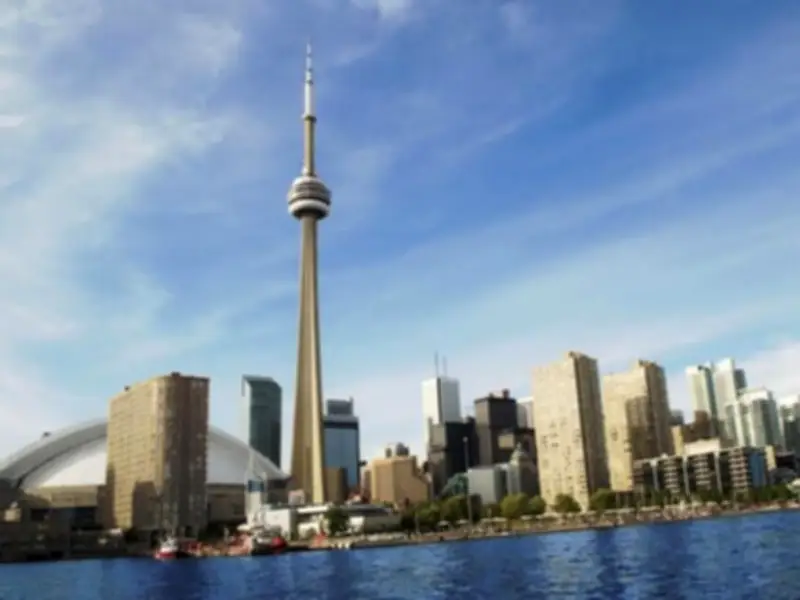
When the CN Tower opens its doors on Friday, it will celebrate its 50th anniversary. At 1,815.5 feet (553.33 metres), it was the world’s tallest tower, building and freestanding structure from 1976 until 2010, and remains the tallest building in the western hemisphere.
Engineer recalls 'lunatic' project
Franz Knoll, the structural engineer who designed the tower's framework, told the Toronto Sun that people called them lunatics for attempting such a feat. 'There were towers before it, but we built something a little bit higher than the tallest we had at the time,' he said.
Knoll, an Austrian-born immigrant, considered himself lucky to be hired by consulting firm headed by architect R. R. Nicolet. In the early 1970s, Nicolet's firm was approached by Canadian National Railway to build the tallest building in the world, showcasing Canadian industry. 'I was very lucky to get into a project like that,' Knoll said. 'At the time I was a fresh immigrant, and it worked out that I was blessed with this task.'

Design and construction milestones
The principal members of the design and construction team included Ned (Edward) Baldwin, architect; Roger Nicolet, structural engineer; Franz Knoll, structural designer; Frank Tam, structural site engineer; Jules Petrinec, mechanical engineer; Jim Armstrong, electrical engineer; and Andre Jordan and Jack Whyte of Foundation Company of Canada, responsible for construction.
The tower has been recognized by the American Society of Civil Engineers as one of the Seven Wonders of the Modern World. Construction began on Feb. 6, 1973, with 1,537 workers working five days a week. The work was finished on Feb. 22 the following year. The antenna portion was completed on Apr. 2, 1975. The cost was $63 million. The tower weighs 117,910 metric tonnes (130,000 tons).
Challenges and pride
Knoll noted that despite the magnitude of the job, there were mishaps. Construction crews used a slipform mold for concrete; on the first pour, concrete fell out because it was too soft and didn't set quickly enough, forcing a restart. 'We did some testing for it, but it turned out on the first pour we lost some concrete as it fell out of the form, and we had to go back and start anew,' he said.
When asked what he was most proud of, Knoll said: 'That we were able to complete it without any great problems. There were problems on the way, of course, and with the technology that went into it at the time was, just to take it to stand up to something that had never been done before.'
Climate of trust
Knoll emphasized the collaborative spirit of the project. 'This one was outstanding, and it was done in a climate of trust,' he said. 'All the main participants, I mean we could have been a source of contention, but it wasn’t. We were able to work together in a productive and friendly way without going to court. That is always a risk you take with large projects, as they end up in court because it is a money issue.'