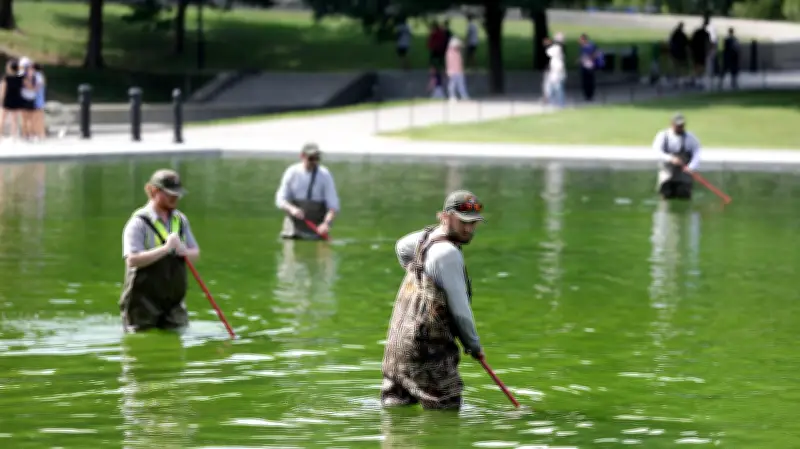
President Donald Trump's $14 million renovation of the Lincoln Memorial Reflecting Pool has resulted in a green algae bloom, with critics describing the water as "puke green" and "split pea soup." The pool was drained and repainted a color Trump calls "American flag blue" to achieve sparkling water, but the project failed to address underlying infrastructure issues.
Algae Bloom Emerges After Renovation
The New York Times reported that no plans were made to fix the pipes, and the paint job alone cannot solve the longstanding algae problem. Workers are now struggling to control the bloom ahead of the 250th anniversary celebrations planned around the Fourth of July in Washington, D.C.
"Treatment of algae blooms is very costly and time-consuming, so we will have to see what happens before July 4," said Sarah Goodrich, an adjunct professor in the geography department at the University of Cincinnati.

Factors Fueling Algae Growth
Multiple factors make the reflecting pool an ideal environment for algae. "Algae blooms can occur when there are hot temperatures paired with stagnant water, in addition to high nutrient inputs such as nitrogen and phosphorus," Goodrich explained. The pool holds approximately 6.5 million gallons of water, making control challenging.
Steve Goodale, owner of Swimming Pool Steve pool service, noted that algae growth is natural in stagnant water. "Swamps, and you know very well what they look like — green and full of growth and algae," he said.
Darker Paint Worsens Problem
Painting the pool a darker color likely exacerbated the algae issue. "It's a massive surface area of a relatively shallow body of water, which was just changed to a darker color than it was previously ... if you take a body of water and you change it from a light color to a dark color, it will absorb more heat," said Goodale. Warmer water directly promotes algae growth.
Goodrich added that certain paints contain nitrogen and phosphorus compounds that can fuel algae. "Any algae that was present in the water upon re-filling the pool may have been able to grow exponentially due to the weather conditions, increased sunlight and potential of nutrient compounds in the paint used for the pool," she said.
"Sabotage" Claims Dismissed
Some Trump supporters have suggested the algae bloom is sabotage by Democrats, but experts dismiss this. "Algae is readily making its way into the pool already because of its open-air environment," Goodale said. "Nobody needs to add algae to my pool, I can still end up with algae in my pool."
Katie Martin, a spokesperson for the Interior Department, called the algae "residual algae" from dormant pipes. Goodale responded that while it could contribute, the water was likely to turn green regardless.
Hydrogen Peroxide Treatment
Workers have poured hydrogen peroxide into the pool to combat algae, but experts are skeptical. Hans W. Paerl, a research professor at the University of North Carolina at Chapel Hill, said the chemical "may work, but it's really only a temporary fix, because the hydrogen peroxide is active for only a few weeks or so." He noted that multiple applications would be expensive.
Goodale added that a tanker truck would be needed to make a real difference in 6.5 million gallons of water. A nanobubbler system has also been installed, which uses ozone to oxygenate the water, but the pool remains vulnerable to environmental contamination from pollen and duck poop.
Climate Change Impact
Climate change is expected to worsen algae problems. "The real basic problem is algae like it hot ... so to speak, and this is probably the worst time if you're hoping to keep clear water in a place like the Reflecting [Pool], because it's hot," Paerl said. He noted that blooms are now appearing in northern regions as temperatures rise.
"The window of opportunity for these blooms is expanding because of climate warming," Paerl added, suggesting that algae removal efforts may become more frequent in the future.