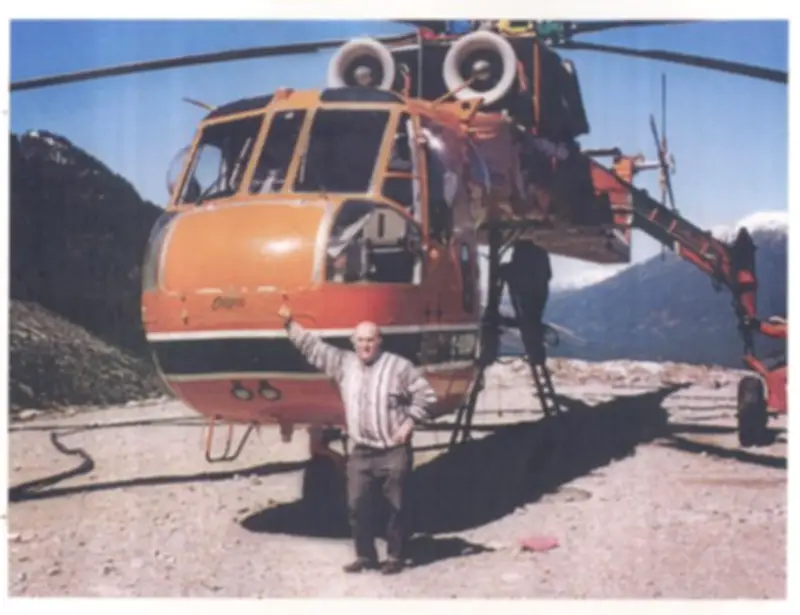
One of the enduring moments in the construction of the CN Tower occurred when 'Olga' lifted the final section of the 102-metre steel broadcasting antenna into place, making history. The tower celebrates the 50th anniversary of its opening on Friday, with the exterior completed on April 2, 1975, and the tower opening to the public on June 26, 1976.
Olga the Helicopter: A Vital Role
The helicopter in question was a 10-ton Sikorsky S-64E Skycrane flown from the U.S. to help complete the job. 'Olga' was rented in the spring of 1975 at a cost of US$230,000. The helicopter decreased the construction time by an estimated five months. But 'Olga' almost didn't get the chance to prove her worth on the maiden flight with Larry Pravecek, Rip Green, and David Korhonen at the controls.
Using helicopters at high altitudes for this specific purpose was virtually unheard of at the time. 'I wasn't there at that time,' CN Tower structural engineer Franz Knoll told the Toronto Sun. 'To do that kind of work with a helicopter, of course it is a challenge as you have to lower these pieces with a precision that is hard to get with a helicopter.'

Challenges During the Operation
The job seemed rather simple at the time: lowering a harness and attaching it to the 80-foot-long front boom of the crane, with iron workers extracting the pins so the copter could lift the boom and lower it to the ground. But the real measure of any solid game plan comes when you get punched in the mouth first, and everything changes.
'When the ironworkers extracted the pins from the south side of the boom, it was found that the harness attaching the boom to the helicopter had not been exactly balanced and when the pins were extracted from the south side, the boom lurched and twisted,' said Malachy Grant, director of design and construction, during a speech at the Empire Club in Toronto. 'When the pins on the north side of the boom were to be extracted, it was found that they were twisted and jammed. Torches were brought into position and the slow process of burning out the pins took place.'
There were other factors at work that the team didn't take into account that day. The effect of the wind, the effect of the tower on the surrounding air currents, and the uplift from the tower itself proved tricky to navigate for the pilots.
Fuel Crisis and Resolution
Grant says he could see his life flashing before his eyes, the worst possible scenario not really much of a thought beforehand. 'The helicopter only carried about 50 minutes of fuel, because of the fact that the operation was expected to take 10 minutes,' Grant said. 'The public generally were not aware of this fact, but as the minutes ticked by the helicopter was still hovering over the boom. After half an hour, I could foresee the necessity, because of the lack of fuel, of the helicopter having to dump the load, the balance of the helicopter operations being cancelled and the whole project being held up for about six months while the antenna was erected in a conventional manner.'
As it turns out, all of the drama was but a minor footnote into the main attraction of Toronto's ever-growing skyline. 'The iron workers successfully burned out the twisted pins, the boom swung loose, and the helicopter very slowly and gracefully lowered the boom to the ground,' Grant said.