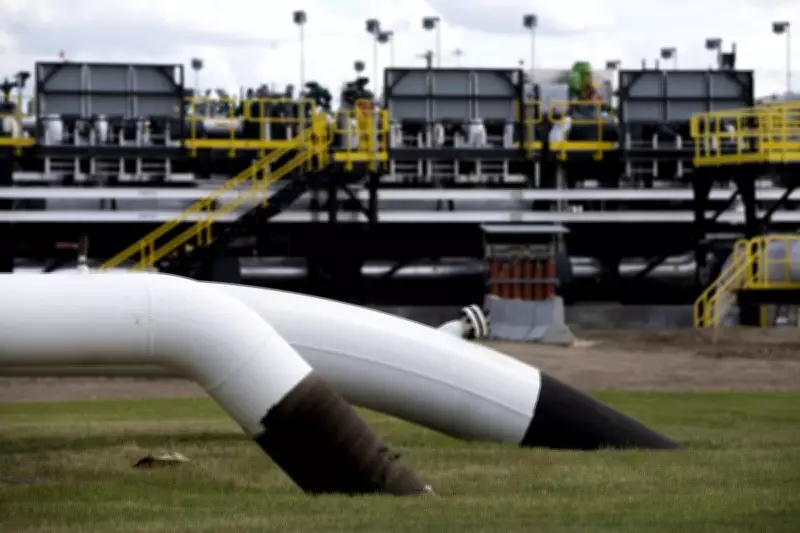
Another U.S. president, another pipeline permit. Last week, Donald Trump signed an order authorizing a new cross-border oil pipeline from Canada to Wyoming — a project echoing the long-debated Keystone XL. For Alberta’s oil sector, it’s welcome news. But for Canada, it should be a sobering reminder of a dangerous cycle we’ve seen before: America giveth, and America taketh away.
Historical Dependency on U.S. Energy Policy
Historically, Canada’s energy policy has been held hostage by U.S. political swings. We export over 99 per cent of our oil south, making us captive to presidential whims. Keystone XL became a painful symbol of this — approved, delayed, revived, and axed across four administrations. The ultimate cancellation of Keystone XL in 2021 alone wiped out an estimated $9 billion in planned capital investment and over 10,000 projected construction jobs. Each flip-flop costs us time, capital, and confidence, reinforcing a pattern of strategic uncertainty that has plagued the sector for decades.
Trump’s Motives and Canada’s Position
Trump’s latest move appears driven by wartime realities. With conflict in Iran roiling global oil flows, stable Canadian crude looks attractive again. Yet this same president has repeatedly claimed America doesn’t need our energy. His reversal proves a hard truth: To the U.S., Canada is a convenience, not a commitment. We are the reliable fallback option in a crisis, not the partner of first resort.

Past Diversification Failures
In the past, such U.S. approvals led us to hit pause on our own diversification. The abandoned Northern Gateway project, after a decade of regulatory effort and an estimated $500 million spent by proponents, stands as a monument to lost opportunity and momentum. Meanwhile, Trans Mountain’s expansion became a marathon of delays, legal challenges, and ballooning costs — taking two decades to complete at a final price tag over four times its original budget.
Whenever a U.S. door cracked open, our push to the West Coast lost urgency. That was a strategic mistake. Repeating it now would be foolish.
Trans Mountain Success and Economic Benefits
The recent success of the expanded Trans Mountain pipeline shows what’s possible and what we’ve been missing. Since coming online, it has unlocked access to Pacific markets, with exports to non-U.S. markets increasing to 676,000 barrels per day in November 2025 from 234,000 b/d in November 2024.
Crucially, this oil commands a higher price. The discount Canadian heavy oil typically faces in the U.S. market — which has cost the national economy tens of billions in lost revenue annually — narrows significantly when sold overseas. It proves diversification is not just a geopolitical strategy; it’s an economic imperative.
Need for Further Diversification
Yet one pipeline isn’t enough. Global demand is shifting, and Canada remains dangerously over-reliant on a single neighbour. Even with Trans Mountain online, over 90 per cent of our crude exports will still flow south. The newly proposed West Coast pipeline, championed by Alberta’s government, is the logical next step. It would open more capacity to Asia, strengthen our energy security, and benefit the national economy.