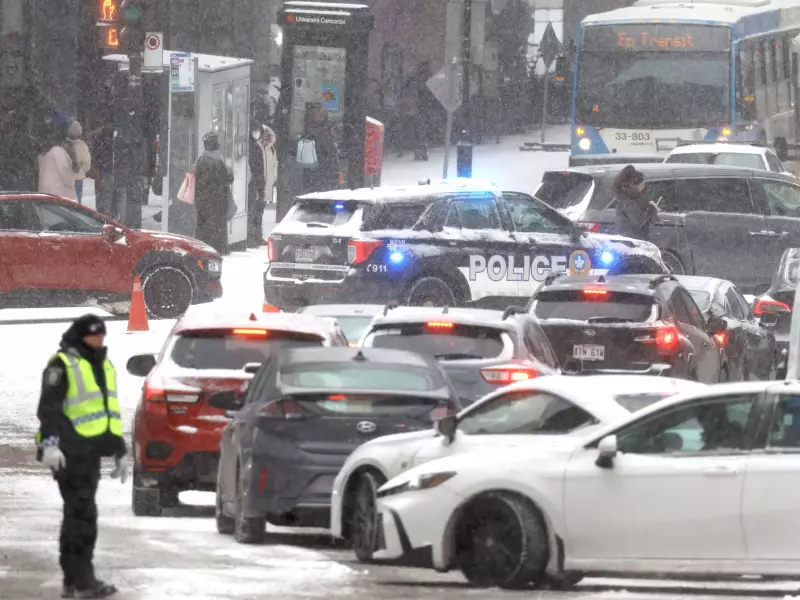
A sudden winter onslaught during the morning rush hour on Thursday, January 16, 2026, brought Montreal to a grinding halt. The season's fourth significant snowstorm, characterized by a rapid transition from icy rain to accumulating snow, overwhelmed city streets and crippled public transit systems.
Transit Systems Paralyzed by Slick Conditions
The storm's timing proved disastrous. City crews appeared to be caught off guard, with many major arteries not salted in time for the commuter crunch. This led to dozens of buses being immobilized or stuck behind stranded cars. Key routes like Sherbrooke Street, Robert Bourassa Boulevard, and Parc Avenue became scenes of gridlock.
Laurence Houde Roy, a spokesperson for the STM, confirmed the severity in a statement to the Montreal Gazette. "Around 8 a.m., we had about a dozen buses on Line 165 and 465 that were immobilized on Côte-des-Neiges Rd. because of slippery conditions caused by a lack of abrasives," she said. The problem was widespread, with buses unable to move or trapped behind stuck vehicles on notorious hills like Beaver Hall Hill and Ridgewood Avenue.

The city's newest transit line, the Réseau express métropolitain (REM), was also severely impacted. Service was disrupted for most of the morning rush hour, starting with a full shutdown between Deux-Montagnes and Central Station at 5:45 a.m. The issue was attributed to ice accumulation on the overhead electrical wires. Full service was not restored until approximately 9:30 a.m.
Road Closures and Hazardous Driving
The dangerous conditions forced police to close Côte-des-Neiges Road after vehicles failed to navigate its steep incline. Major highways, including Highways 40 and 20, were described as notably slippery, with traffic crawling slower than usual across the network.
Interestingly, despite the chaos, towing services did not see a dramatic spike in calls. Nicolas Ryan, a spokesperson for CAA-Québec, reported about 2,700 calls for towing, which he described as only slightly above average. "I believe many people stayed home," Ryan speculated in a phone interview, noting the situation was not out of the ordinary for a winter storm.
Potholes Emerge as a Secondary Menace
Ryan highlighted a related and growing problem for Montreal drivers: potholes. The recent freeze-thaw cycles have severely damaged road surfaces. "We had 20 per cent of our calls due to blown tires, which is much more than our average of seven to eight per cent," he revealed. This winter has been particularly harsh, with colder-than-normal November temperatures and above-average snowfall already straining infrastructure and vehicle maintenance, including a high rate of dead batteries during the holiday cold snap.
The City of Montreal did not provide a comment in time for the publication of the initial report. The storm served as a stark reminder of the challenges posed by Quebec winters and the critical need for timely road maintenance to keep the city's vital transportation networks functioning.