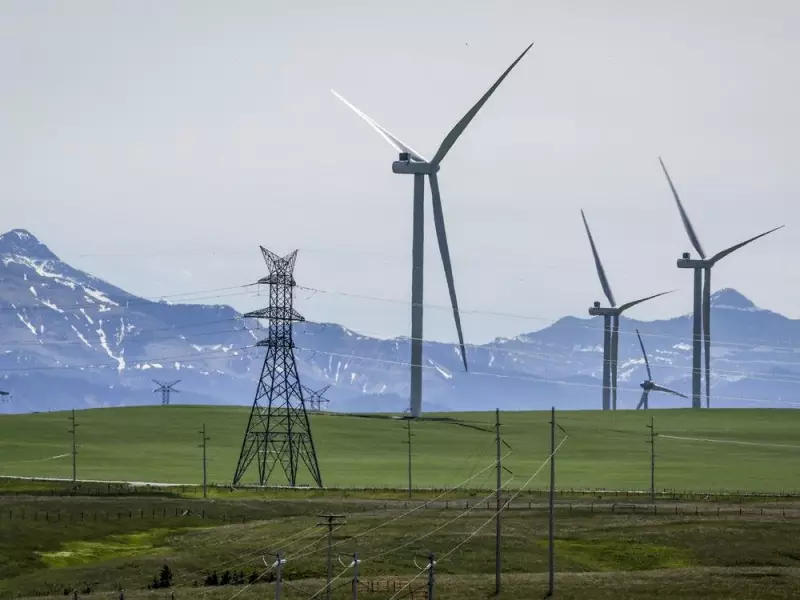
Municipalities across Alberta have achieved a significant financial milestone, collecting a record $70.7 million in revenue from renewable energy projects this year, according to a new analysis. However, this financial boon is shadowed by concerns that future projects are in jeopardy following provincial policy changes.
Record Revenue and Its Sources
The Business Renewables Centre-Canada (BRC-Canada) released its latest findings on Tuesday, revealing a dramatic 30 percent increase in municipal revenue from renewables, jumping from $54 million in 2024. This year's total represents a staggering 151 percent growth compared to the $28 million collected in 2023.
This financial benefit is now shared by 26 rural municipalities, meaning approximately one-third of them are now receiving income from wind and solar projects. A crucial detail from the analysis indicates that all projects generating this 2025 revenue were initiated, approved, and constructed prior to the Alberta government's imposition of a moratorium on large-scale renewable project approvals in August 2023.

The Looming Threat to Future Projects
While the moratorium was lifted in February of this year, the period of uncertainty has cast a long shadow. Carson Fong, Program Manager for BRC-Canada, stated that the "prolonged period of market redesign and policy overhaul" has had a "dampening impact" on the corporate renewable procurement market in Alberta.
According to the BRC-Canada's review of the Alberta Electric System Operator (AESO) project queue, there is significant potential for an additional $76 million in revenue for 21 municipalities from projects currently in development. Despite this potential, the report warns that many of these projects are now "at risk of cancellation" due to a lack of policy certainty.
Market Redesign and Investor Hesitation
Following the end of the moratorium, the AESO embarked on an 18-month consultation process to redesign the provincial energy market. This Alberta electricity market refresh, scheduled to take effect in mid-2027, aims to improve grid reliability and maintain affordable consumer prices.
Aaron Engen, CEO of the AESO, said in late August that the restructuring builds on key principles of the existing market while introducing new tools to boost reliability and protect consumers. While a broad framework for the new market design exists, Fong points out that the critical details are still missing.
"We don't know the details of specifically how a lot of these concepts will be implemented," Fong explained, noting that the changes are "set to significantly change the costs that projects have to bear, how costs are allocated, as well as the revenues these projects can collect."
This ambiguity has caused investors to adopt a wait-and-see approach. "The concern is that a lot of them have just gone elsewhere, to other places to invest," Fong said, highlighting the economic opportunity that Alberta risks losing without clearer, finalized rules for its renewable energy sector.