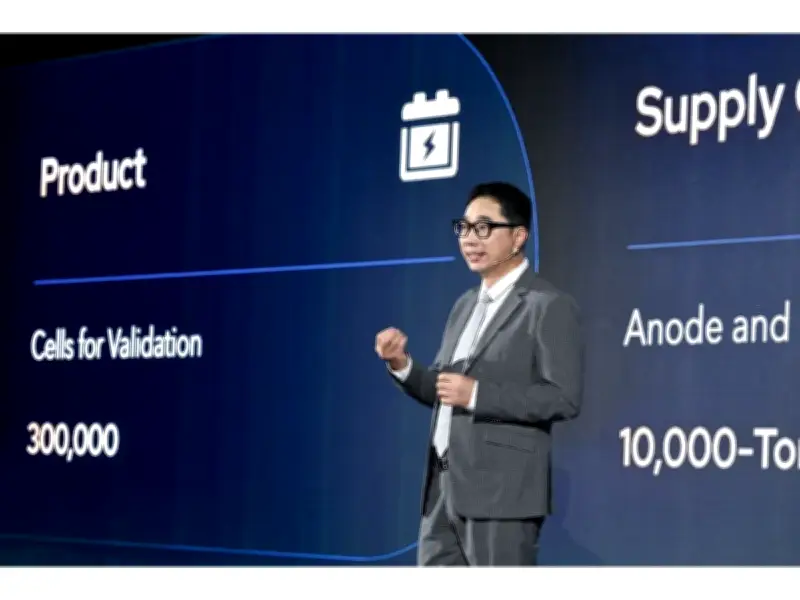
On June 22, 2026, CATL officially unveiled the TENER Sodium Energy Storage System in Munich, Germany, marking the world's first real-world validated sodium-ion energy storage solution. The system has achieved full commercial maturity across technology, production capacity, and supply chain readiness. CATL expects cumulative shipments to reach 1 GWh by the end of 2026, with global deliveries beginning in June 2027.
Addressing Supply Chain Risks with Sodium Technology
As renewable energy adoption rises and AI-driven power demand surges, energy storage has become critical infrastructure. Conventional lithium-based systems face concentrated supply and volatile prices. Sodium—over 1,000 times more abundant than lithium and widely distributed—offers better extreme-temperature performance, safety, and cost potential, making a technology transition inevitable, according to CATL.
William Wu, Director of CATL's Energy Storage Technology Center, stated at the launch: “CATL is committed to promoting energy independence around the world while delivering long term value for our customers. To achieve this we have made it our mission to develop a new battery chemistry based upon abundant resources available across all continents, one that can support the energy needs of all eight billion people, while offering longer cycle life and enhanced safety. We believe that sodium and lithium together will form the twin foundations of the future energy storage system.”

TENER Sodium: Modular Architecture and Customer Benefits
Powered by CATL's latest sodium-ion technology, TENER Sodium delivers more than 30 MWh of rated capacity on a fully modular architecture. This design provides three direct benefits for customers:
- Simpler project deployment: Each single module weighs about 42 tonnes, and only 34 units are required for a 1 GWh site.
- Greater configuration flexibility: Energy and power blocks are decoupled to support flexible storage durations of 1, 2, 4, 6, and 8 hours, tailored to specific project requirements.
- Lower maintenance cost: Faulty modules can be quickly isolated and replaced independently, improving station-level system availability while reducing customer OPEX and maximizing asset utilization.
Amanda Xu, CTO ESS and President of ESS Europe CATL, emphasized in her keynote: “The energy storage industry has moved beyond a race for scale. Today, success is increasingly defined by the ability to create long-term value. The principle we most firmly believe in is that readiness creates certainty.”
CATL positions TENER Sodium as a solution for an uncertain future, where energy storage must provide reliability and long-term value amidst growing renewable penetration and AI-driven demand.