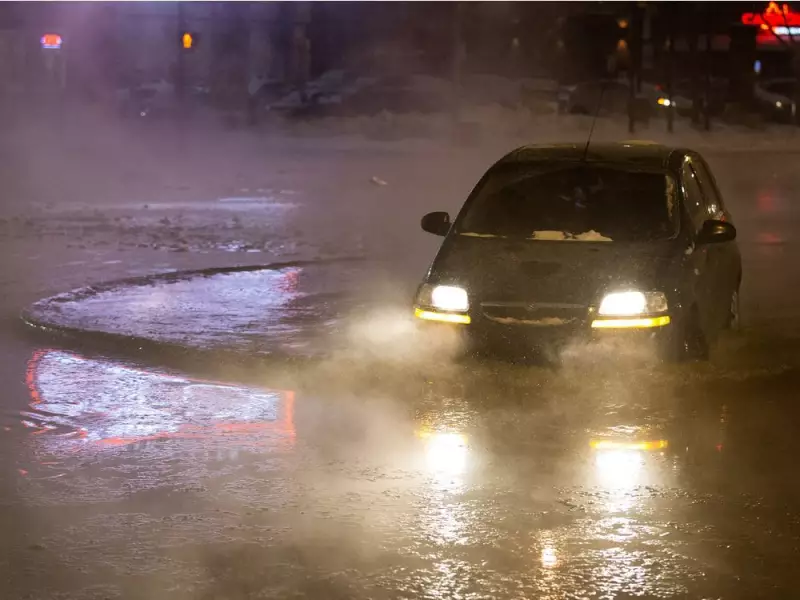
With Calgary grappling with its second major water main rupture in under two years, residents of Edmonton might be looking uneasily at their own taps. The security of a city's water supply hinges on the unseen network beneath its streets, and experts confirm that no system is entirely immune to failure.
The State of Canada's Aging Water Networks
Dr. Alireza Bayat, a specialist in underground infrastructure and drainage, told Postmedia that the condition of pipeline networks is the primary factor for municipal water security. Most of these pipes are 50 to 80 years old in design, he stated, noting that studies have found about one-third of water pipes across the country are in poor condition.
He highlighted a U.S. study indicating that cast-iron pipes, a legacy material in many systems, can rust up to three times faster due to climatic factors. Nationwide, Canada experiences between 15,000 and 20,000 water pipe breaches every year, Bayat said, emphasizing that this is a significant national issue, not confined to Alberta's major cities.

How Edmonton's System Differs from Calgary's
While constructed around the same era, the water systems in Edmonton and Calgary have key structural differences. Calgary, situated on the flood plains of the Bow and Elbow Rivers, relies heavily on pumps to move water to its elevated neighbourhoods. This process can create damaging pressure surges, known as "water hammer," if pumps are switched on or off abruptly.
In contrast, Edmonton's topography, largely elevated above the North Saskatchewan River and less hilly, allows it to utilize gravity to maintain flow throughout much of its system. Pumps are primarily used to lift raw water from the river into treatment plants before it enters the distribution network.
Dr. Bayat outlined four critical questions for assessing any water network: the extent of active monitoring for critical infrastructure, the annual inspection rate, the percentage of pipeline nearing end-of-life, and the amount of legacy material like cast-iron still in use.
Epcor's Assurance: Decades of Proactive Investment
Edmontonians have little cause for concern, according to Martin Kennedy, Epcor's director of communications. He stated that the city-owned utility has prioritized network renewal for decades and maintains a confident understanding of its pipeline infrastructure's condition.
Kennedy pointed to data showing a consistent decline in water main breaks. Since 2010, Epcor has repaired between 201 and 393 breaks per year. He emphasized that the rate of breaks has decreased even as Edmonton's population and footprint have grown substantially.
This performance is attributed to a long-standing focus on Performance Based Regulation (PBR). Another key metric Kennedy cited is the system's water loss. Epcor loses an average of just 5% of its water annually, a figure dramatically lower than the national municipal average of 17% lost to leaks.
Substantiating its commitment, Epcor reinvested $412.4 million back into its water and wastewater infrastructure in 2024 alone. This ongoing capital program focuses on renewing both the distribution lines that bring clean water to homes and the sewage lines that return it for treatment.
While experts caution that no infrastructure is invincible, Epcor's message to Edmonton is clear: sustained, strategic investment has built a resilient system designed to prevent a crisis, not just react to one.