Every year around this time, I wonder what I am supposed to do with myself. Mother's Day is one of America's prettiest holidays. It is full of flowers and brunch and pastel dresses with skirts full of gratitude for the matriarchs who gave us life. But for me, as someone whose mother died when I was a child, the second Sunday in May and the weeks leading up to it all feel like an endless slog. I feel boxed in to perform a certain kind of grief that is tender and sweet, like the praise everyone else gives to their living mothers. Mother's Day-appropriate grief looks like talking about how I miss my mom's hugs and her cooking, the way she braided my hair before school, or maybe sharing an Instagram collage of sepia-toned photos captioned with the one-two punch of a white heart emoji plus angel wings.
There is very little room in that Mother's Day aesthetic for grief that is not soft or pretty. Like mine. I have seen many a watercolor Pinterest quote lamenting 'grief is love with nowhere to go.' But for me, sometimes grief is anger with nowhere to go. So, where does my grief fit in this time of year, as the girl whose mother died slowly, who has no memories of her mother getting her ready for school, and as the daughter who inherited not recipes but warnings about how cruel the world can be?
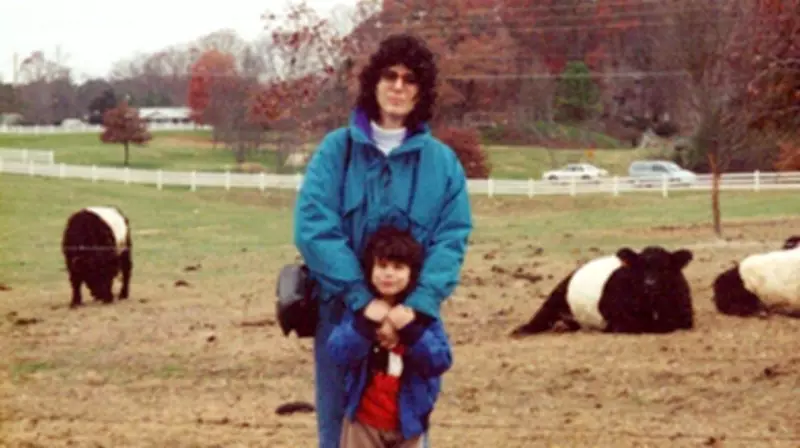
The author and her mother, Susan, at Fearrington Village in Pittsboro, North Carolina. 'This was one of her favorite places to visit with us as kids,' she writes.

Mom was diagnosed with glioblastoma, the deadliest form of brain cancer, when I was 5 years old and she was 45. My 5-foot-10, brilliant, academic mother lived eight more years, helped by experimental treatments. But 'living' is not really the word for what those final years became, especially for someone as accomplished and poised as she had been. She was some version of herself for the first couple of years, but the rest were a terrible, long decline.
Illness swallowed so much of her voice before I was old enough to really know her. And, to this day, even if pressed, I draw a blank when it comes to stories my mother told me about her own life.
Except for one.
I could not have been more than 6 years old when she held my hand by the carousel at Northgate Mall in our hometown of Durham, North Carolina. Mom crouched down on my level to tell me a story about something humiliating that had happened to her only a few feet away, long before I was born. My mother was in her 20s and carrying a couple of shopping bags while she walked down the mall corridor alone. A line of teenage boys came around the corner in the opposite direction, and one of them abruptly reached his arm out and grabbed her crotch in a violent handful. The group of them continued on, laughing and exchanging high-fives. No one else around my mother seemed to notice. So, she kept walking, shaking off the shock.
And now, as I write this, I wonder if the real story of my mother's sexual assault was even worse than what I remember her describing. Was this the more child-friendly version of what really happened?
Of all the conversations my mother and I could have had together by the carousel that day, knowing she had terminal cancer and knowing her young daughter would grow up motherless, this is a story she highlighted for me, and that I remember so vividly.
Why?
The reasons are devastating and obvious to me now as an adult. I was told and I remember this story because my mother wanted me to be prepared. She wanted me to know that these things happen to women and girls, even though they should not. She also wanted to make clear that if something like this happened to me, I should tell someone and not just shake it off — because in our house, I would be believed.
Many women carry some version of this unwelcome inheritance: stories their mothers told them early about what men — old and young — did to them, where they were touched, when they were followed, when no one helped or believed them. Stories told in whispers over folding laundry, between commercial breaks or in parking lots to children in car seats.
It is a grim rite of passage from mother to daughter that I was not spared from simply because my mother was dying.

This Mother's Day season, I am, of course, thinking about my mom. And I have found myself thinking about this story in particular because it feels especially incongruous to go all-in on the aesthetics of a holiday about honoring women, when I look around and see how little women seem to be valued in America — if at all. When I was in kindergarten, my mother was already warning me to be vigilant. Decades later, America elected a president who famously bragged about grabbing women 'by the pussy.' That vulgar phrase — excused as locker-room talk and shrugged off by millions of Americans — was an exact description of what happened to my mother that day at the mall. She was sexually assaulted while boys laughed and strangers looked away. And even now, the misconduct and sexual violence of Harvey Weinstein, Sean 'Diddy' Combs, Jeffrey Epstein and too many other men prove that these stories are very much still worth warning us about.
I feel my mother's absence every day, and it is especially urgent this time of year. My grief is anger that my mother died, and anger that she suffered for years before she died. It is anger that she had to teach me about violence before she got to teach me so many other things. Anger that women are still expected to absorb shame quietly and move on. Anger that in 2026, we are still arguing over whether women are believable.
This Mother's Day, I am tired of trying to squeeze myself into someone else's tidy narrative about what love and grief are supposed to look like. Instead, I am going to honor my mother's full legacy — not just the parts that fit neatly into an Instagram caption. I am going to hold the beauty of the day alongside my ire, and the tenderness alongside the truth: I feel anger for the world she had to prepare me for.
Rage is my inheritance, too.
Rebecca Feinglos is a certified grief support specialist, founder of Grieve Leave, and host of the 'Grief'd Up' podcast. After losing her mother as a teen, her father in 2020, and navigating a divorce, she took a grief sabbatical, and Grieve Leave was born. The platform now reaches millions, offering real tools, humor and honest conversation to help people take intentional time to grieve. Rebecca previously worked as a policy adviser in state and local government, and began her career as a bilingual educator. She holds degrees from Duke University and the University of Chicago. Her voice has been featured in Time, the LA Times, Fortune, Slate, Elle and more. She splits her time between North Carolina and Montreal with her dogs, Daisy Duke and Ralphie.