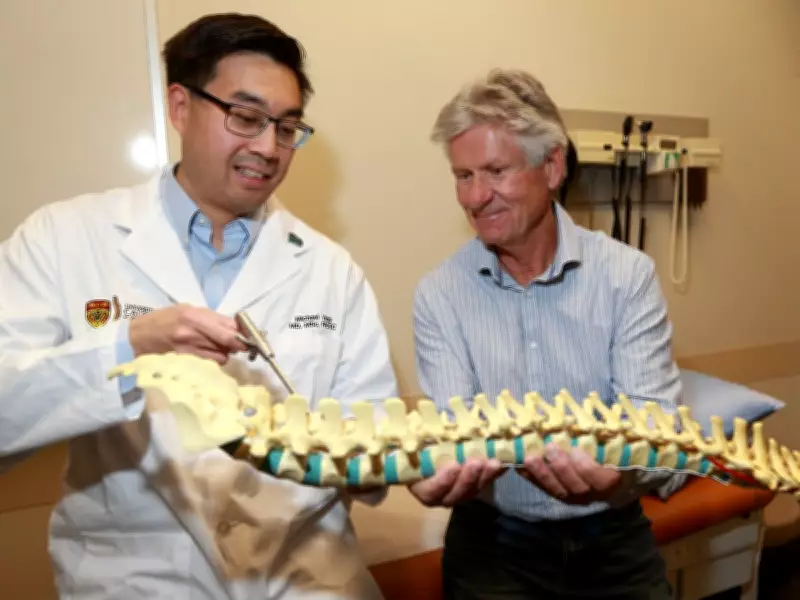
Alberta Health Services is promoting a new minimally invasive spinal surgery that has dramatically reduced recovery times from months to hours. The procedure allows doctors to perform complex operations without large incisions or significant trauma to patients.
Innovative Endoscopic Technology
The new technique uses endoscopic technology, where a thin cylindrical instrument is inserted through a seven-millimetre incision—about the size of a pencil. A camera guides surgeons to precisely remove herniated discs from the spinal canal.
"In traditional surgery, this would be open, would be bloody, you're using large instruments to do the surgery," said Dr. Michael Yang, a spinal neurosurgeon at Foothills Medical Centre in Calgary, who leads the program for this technology. "Now we're able to do it under constant saline irrigation and then remove the discs ultra minimally. With the camera, we can sneak in to directly visualize everything."

Program Details and Funding
The Calgary Endoscopic Spine Surgery Research Program was seeded with $8.2 million from the Calgary Health Foundation. It focuses on two procedures: endoscopic spine surgery and lumbar fusion surgery. The former removes tissues pinching spinal nerves, while the latter involves installing screws and rods to stabilize the spine. These surgeries treat conditions such as spondylolisthesis and myelopathy.
"We don't have to remove any soft tissue or disrupt any muscle," Yang explained. "We make a skin incision, and this camera goes in here, into the space, and, voila, we see the disc herniation, and we're able to take out the disc herniation or compression, to relieve the pressure off the nerves."
Background and Approval
The program launched in 2025 after Yang identified a gap in spinal surgery offerings in Canada. He learned the technique during his residency at the University of Miami in 2021. Such procedures are common in the U.S., and Yang worked to bring the technology to Calgary, now one of a handful of cities offering it. Although the surgery is FDA-approved, it has not yet been signed off by Health Canada, requiring Yang to seek approval for each individual operation.
Patient Experience
Dale Bingham, a resident of Red Deer, was among the first patients to undergo the new procedure. A former copper cable splicer, he suffered from a condition where nerve tissue squeezed into his spinal cord, causing severe pain that required heavy painkillers. "I said, 'Let's do it,'" Bingham recalled. "I had no qualms at all. I was more nervous today than I was going in for my operation." Within two hours of the procedure, he was able to walk.