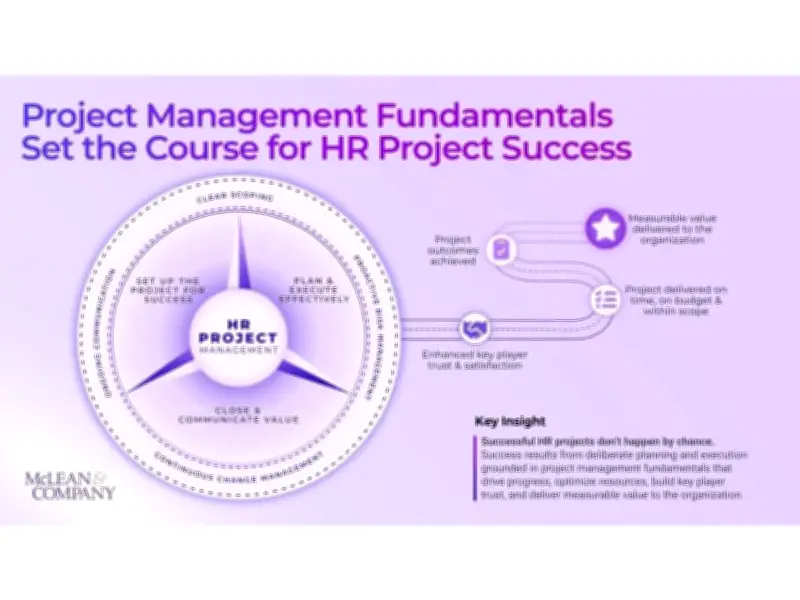
Only 19% of HR departments are highly effective in project management, according to new research from global HR research and advisory firm McLean & Company. The firm's 2023–2025 HR Management and Governance Survey, based on 1,681 respondents, reveals a significant capability gap as HR takes on more strategic initiatives.
Blueprint Offers Structured Framework
To address this gap, McLean & Company has released the blueprint "Get Started with HR Project Management." The resource provides a practical three-step process, tools, and templates to help HR leaders strengthen project setup, planning, execution, and closure. The framework covers clarifying project scope, engaging key players, planning and executing work, managing risk, sustaining communication, and closing projects to capture lessons learned and demonstrate value.
Why HR Project Management Matters
As HR departments handle organizational redesign, employee listening strategies, HR technology, and AI implementations, effective project management is critical for delivering measurable business value. However, few HR departments have the fundamentals to consistently deliver projects on time, in scope, and with clear impact.

"Successful HR projects don't happen by chance," says Lexi Hambides, Director of HR Research & Advisory Services at McLean & Company. "Success results from deliberate planning and execution grounded in project management fundamentals that drive progress, optimize resources, build key player trust, and deliver measurable value to the organization."
Common Gaps in HR Project Management
McLean & Company explains that ineffective project management is not due to lack of intent or effort but often stems from missing fundamentals: structured planning, effective scoping, proactive risk assessment, key player engagement, and ongoing communication. Without these, projects face missed deadlines, rework, scope creep, and dissatisfaction, limiting HR's ability to deliver on strategic priorities.
Strategic Imperative for HR
The research emphasizes that project management is no longer a nice-to-have capability. As HR's scope expands, structured planning and execution enable teams to deliver strategic impact without sacrificing operational rigor, consistency, or credibility. By applying project management fundamentals, HR leaders can improve workload management, build trust with key players, and deliver stronger outcomes for employees and the organization.