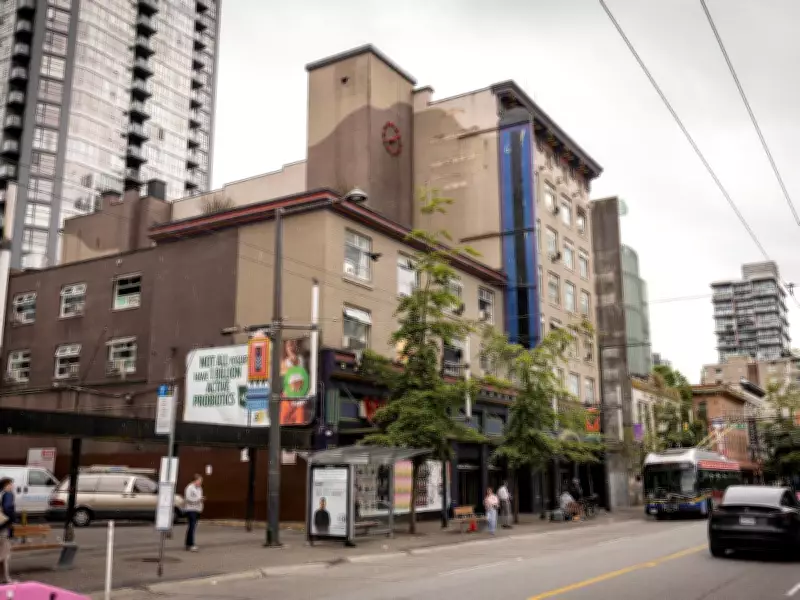
Just six years after the British Columbia government spent $56.5 million converting a Vancouver hotel into a low-barrier homeless shelter, the facility has been revealed as an unsalvageable biohazard. The former Howard Johnson hotel, now called Luugat, was repurposed in 2020 into a 110-room full-service shelter that allowed pets and on-site drug use, including a vending machine dispensing free needles, crack pipes, and other drug paraphernalia.
According to the shelter's still-active website, Luugat primarily catered to low-income individuals and operated with round-the-clock staff, offering comprehensive support, free meals, free housekeeping, and timely maintenance. However, after years of constant fires and floods, the interior has been described as an unliveable nightmare of collapsed ceilings and hoarded garbage.
Devastating Conditions Revealed
Last week, Global News obtained video footage showing one of Luugat's rooms stripped of furniture and piled with an estimated four feet of garbage, all soaked by an overflowing toilet. The video was shot by Allan Goodall, owner of a nightclub on the building's first floor, who has regularly faced ceiling collapses from the rooms above. Former resident Stewart Holcombe told the broadcaster that multiple rooms are inaccessible due to caved-in roofs. When a camera crew requested a closer look, B.C. Housing denied access, citing privacy concerns.

Alarming Emergency Statistics
According to a tally compiled by the Vancouver Sun, Luugat has been the subject of 906 emergency calls in its six years as a shelter, including 334 alarms, 43 fires, and 12 incidents identified as rescue or hazard events. Holcombe estimated that the building was destroyed within a year and a half of opening and has remained in that state for another 4.5 years. Despite these conditions, the province only announced Luugat's closure in November, along with two other nearby low-barrier shelters.
Part of a Larger Pattern
Luugat is one of nine hotels acquired by B.C. during the early months of the COVID-19 pandemic for a total of $221 million. All were transformed into low-barrier shelters with no restrictions on who could enter or leave, and drug use was encouraged on site. In every case, these hotel conversions quickly became hubs of fires, floods, civic disorder, and organized crime.
Muncey Place, a former Comfort Inn in Victoria purchased for $19.2 million, was raided by police last May, revealing a room used as a drug trafficking headquarters containing one kilogram of fentanyl, $40,000 in cash, and a loaded 9 mm pistol. The Patricia Hotel, bought for $64.4 million in 2021, was the site of an officer-involved shooting a year after opening, when police shot a man who charged them with a knife. In recent years, some repurposed hotels also faced scandals over workers needing respirators to avoid fentanyl smoke. Last summer, B.C. acknowledged the issue by pledging a plan to address air-quality problems related to second-hand fentanyl exposure. According to a 2022 audit, the entire project cost $221 million, averaging $272,839 per room across 810 rooms.