Understanding Winter's Impact on Hair Health
If you're noticing brittle ends and strands that stubbornly resist moisture retention, you're not imagining things. The unfortunate reality is that dry hair and cold winter weather form an unwelcome partnership that challenges even the most resilient tresses. Celebrity hairstylist and hair industry authority Cash Lawless explains to HuffPost that this phenomenon stems from increased negative ions in the atmosphere during colder months.
"Static reaction occurs when negatively charged hair strands encounter negatively charged cold air and begin to repel one another, causing static frizz," Lawless reveals. This ion repulsion creates friction damage that makes hair appear frizzier and more coarse than during warmer seasons.
The Science Behind Winter Hair Damage
Fazia Frederick, a prominent New York-based stylist for Glamsquad, adds another dimension to the winter hair dilemma. She notes that arid winter temperatures significantly reduce atmospheric humidity, directly impacting hair hydration levels. "The cold weather also makes hair more prone to breakage in particular, resulting in split ends and a flaky scalp," Frederick warns.

Jon Reyman, owner and cut director of Spoke & Weal salons, identifies a particularly damaging winter habit: going outside with wet hair. "Usually in colder weather, hair stays wet for longer as the cold doesn't have the evaporative power of heat," Reyman explains. "When hair is wet, it's at its weakest and most vulnerable condition, which leads more easily to damage and breakage."
Reyman further elaborates on the physics of winter hair damage: "When water crystalizes, water expands. Crystallization happens when the temperature is below freezing. If hair is wet, the expansion puts pressure on the hair cuticle and causes damage."
Expert-Recommended Winter Hair Solutions
For optimal hair protection and moisture retention during winter months, these hair professionals recommend specific strategies and products to achieve more manageable, silky, and winter-proofed locks.
1. Humectant-Infused Leave-In Conditioner
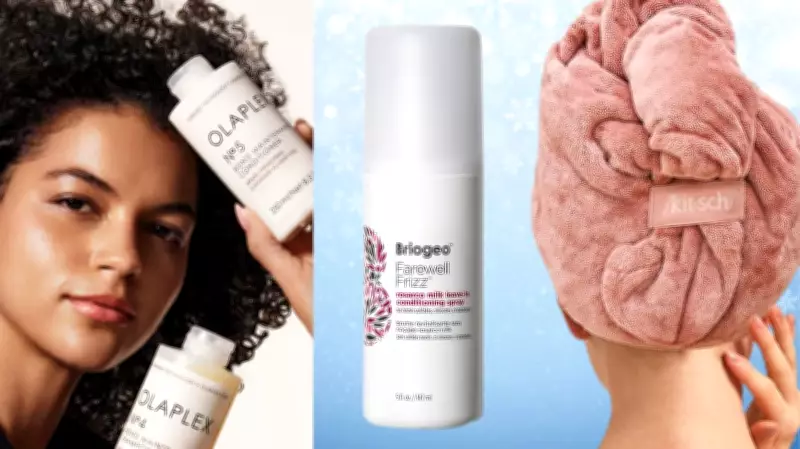
Lawless suggests incorporating products containing humectants like glycerin or propylene glycol. "A humectant attracts moisture in the air to the hair. These are not great in humid climates, but might be beneficial in very cold arid climates," he advises. Briogeo's leave-in conditioning milk combines plant-derived glycerin with nourishing oils like rose hip and argan to protect against free radical damage while sealing in moisture.
2. Positively Charged Ion Shampoo and Conditioner
To counteract negative ion repulsion, Lawless recommends bonding products containing positively charged ions. Olaplex's bond maintenance shampoo and conditioners work by re-linking broken bonds within the cuticle while protecting against environmental stressors, making them suitable for all hair types and color-safe.
3. Conditioning Dry Shampoo for Reduced Washing
Frederick emphasizes moisture preservation through reduced shampooing. "Reduce shampooing your hair to once or twice a week in order to further maintain moisture in the hair," she recommends. "For those with fine or more oily hair, a dry shampoo with rice starch is highly recommended between washes." Klorane's rice starch-based non-aerosol dry shampoo absorbs excess oil while oat milk soothes the scalp.
4. Heat-Smart Styling Tools
When heat styling is necessary, Reyman advocates for tools that minimize thermal and mechanical damage. Dyson's Supersonic hair dryer uses high-velocity air rather than constant extreme heat, while their Corrale straightener features flexing copper plates and intelligent heat control that adjusts to hair texture, thickness, and length.
5. High-Performance Hair Towels
Reyman recommends starting the drying process with specialized towels like the Aquis Hair Turban. "This limits dry-time. Again, the goal is to limit the amount of time hair is most vulnerable to damage," he explains. Microfiber turbans reduce frizz, breakage, and friction while removing excess water efficiently.

6. Reparative Hair Treatments
For comprehensive strand protection, Reyman endorses the K18 molecular hair treatment. "The science is real. Hair is repaired and conditioned at a level we have not seen before," he states. This leave-in treatment uses a unique peptide complex to reconnect broken keratin strands responsible for hair's elasticity, strength, and softness.
7. Pre-Shampoo Scalp Oils
Addressing dehydrated scalps, Frederick recommends applying scalp oil before washing with lukewarm water. Kiehl's Magic Elixir combines rosemary and avocado oils to nourish irritated scalps and hydrate parched follicles, promoting healthier-looking hair.
8. Daily Leave-In Hydrators
Before drying and styling, Reyman suggests applying hydrators like Harklinikken's leave-in creme. This multipurpose formula with argan and Abyssinian seed oils strengthens, nourishes, and hydrates simultaneously without greasiness, making it suitable even for fine hair.
9. Protective Style Kits for Curly Hair
For curly and tighter hair textures like 4C hair, Reyman recommends protective styles and wet sets to minimize damage and reduce heat dependency. Girl+Hair's three-product set includes shea butter and tea-tree oil shampoo, nourishing leave-in conditioner, and biotin treatment balm specifically designed for protective styling.
10. Heat-Activated Styling Serums
For heat styling protection, experts recommend Bumble and Bumble's repair blow dry serum, which addresses split ends through heat activation. Their bond-building line uses a honey complex to strengthen hair from cortex to cuticle while smoothing the cuticle and adding shine.
11. Overnight Hair Masks
Frederick suggests IGK's leave-in dry hair mask for weekly moisture boosts. Its time-release formula nourishes hair overnight without residue, strengthening and softening all hair types. She emphasizes proper application: "Always apply products in the direction of the hair shaft down to the ends, or for fine and oily hair, mid-shaft down to ends."
12. Ionic-Moisturizing Curling Tools
Frederick also recommends Bio Ionic's professional curling iron, which uses ionic-moisturizing heat technology to create conditioned, lasting curls while actually sealing the hair cuticle. The extended barrel ensures complete section curling, with various barrel lengths available for different styling needs.
Prevention: The Ultimate Winter Hair Strategy
Lawless clarifies the root cause of winter dryness: "If the cuticles that surround and protect each hair strand are unsealed, your hair is susceptible to moisture loss and will have a greater reaction to the negative ions more present in winter."
Both Frederick and Lawless agree that prevention and protection constitute our best defense against winter hair damage. "Reducing exposure to extreme heat, chemicals and friction can help ensure your new growth doesn't experience the same thing your old hair does," Lawless advises. Frederick reinforces this with practical measures: shampooing only once or twice weekly and incorporating hydrating masks to maintain essential moisture levels throughout the challenging winter season.