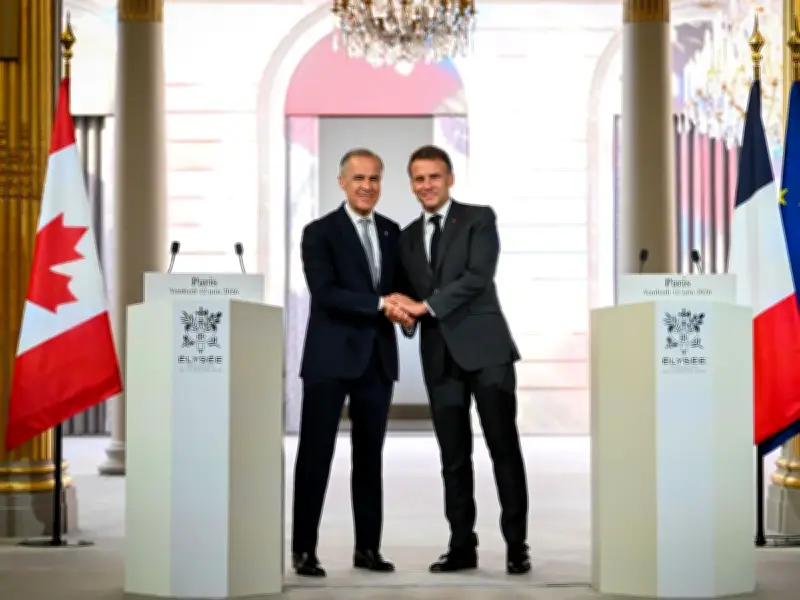
Canadian Prime Minister Mark Carney and French President Emmanuel Macron have agreed to deepen defence and industrial cooperation while easing the exchange of classified information. This move comes as Canada seeks to strengthen its ties with Europe amid volatile United States trade policies.
Key Agreements and Strategic Context
Speaking before talks in Paris, Carney announced that the two countries signed an agreement to share classified information across defence, space, artificial intelligence, and aerospace sectors. He stated, "Working together, Canada, France and Europe are poised to be a powerful force for good in the century ahead."
Carney is scheduled to attend the Group of Seven summit in the French Alps but arrived early to meet Macron. He will then head to Ireland for a two-day visit, part of a steady cadence of trips to Europe that underscores his strategy of building alliances among mid-sized powers.

This approach, outlined in his January Davos speech, aims both to counter geopolitical heavyweights and to bolster Canada’s economy, which has been strained by U.S. tariffs on steel, aluminum, autos, and lumber.
France as a Bridge to Europe
Macron emphasized that France serves as a key bridge between Canada and Europe. He remarked, "More than ever, we share the same understanding of the world. We observe that the international order is fragmented, marked by the return of power politics, by challenges to established rules, by economic coercion, by interference and by information warfare."
Closer European ties have become a defining thread of Carney’s policy agenda. His artificial intelligence strategy calls for a "coalition of aligned democracies" to rival dominant players, and AI is set to feature prominently in discussions with Macron. Canada’s new restrictions on youth social media use also align with priorities championed by the French president.
Defence and Energy Shifts
On defence and energy, the shift is already clear. Canada is ramping up military spending, joining the EU’s SAFE procurement program, and weighing purchases of European fighter jets and submarines. Meanwhile, German utilities have lined up as early buyers of Canadian liquefied natural gas as new export projects advance.
"Europe is Carney’s comfort zone. That becomes quite clear if you look at his pattern of travel," said Roland Paris, a University of Ottawa professor and former adviser to Justin Trudeau. "Europe is central to his plans to diversify Canada’s trade relations beyond the US, and to build new industrial and technology partnerships."
Balancing Act with the US
However, there is a delicate balancing act as Carney tries to get to the negotiating table with President Donald Trump. Moves such as reconsidering the purchase of U.S.-built F-35 jets in favor of Sweden’s Saab AB Gripen risk retaliation, setting up a delicate balancing act ahead of the G7 summit—where both European allies and Trump will be in the room.
Close Personal Rapport
Carney and Macron, who share backgrounds in finance, have developed a close working relationship and are in frequent contact as they seek to attract investment amid U.S. trade disruptions, according to people familiar with the matter. One person described them as "copains comme cochons," a French expression for close friends.