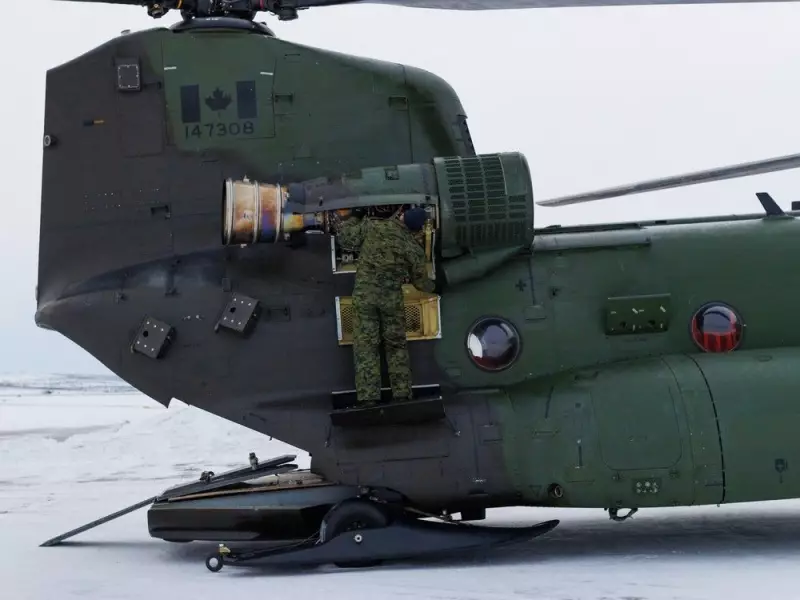
Experts Call for Enhanced Military Presence in Northern Quebec Amid Trump's Arctic Ambitions
As former U.S. President Donald Trump continues to make provocative statements about expanding American control over Arctic territories, defence specialists are urging Canada and Quebec to significantly strengthen their military defences along northern borders. This recommendation comes amid growing concerns about sovereignty in the region.
Immediate Actions Recommended for Sovereignty Protection
International defence experts emphasize that Canada should deploy additional troops to Quebec's northern regions, invest in submarine capabilities, and increase naval patrols through the Northwest Passage. These measures would send a clear message that Canada is committed to defending North America's borders and asserting its sovereignty over Arctic territories.
Maria Popova, an assistant professor of political science at McGill University who specializes in Eastern European rule of law, draws parallels between Trump's rhetoric and Russia's historical approach to Ukraine. "While Canadians shouldn't be worried about tanks rolling into Ottawa," Popova notes, "Trump's talk about increasing U.S. dominion over the Western Hemisphere bears disturbing similarities to Russia's history with Ukraine."

Trump's Consistent Messaging Raises Concerns
Popova expresses particular concern about Trump's repeated references to Canada as the 51st state. "What started potentially as a joke has become quite consistent," she explains. "Trump has been sending these messages that the world is in a new era where the old international order of territorial integrity is over. Now, like Russia, the U.S. appears willing to pursue redrawing of borders for its own purposes."
Canada has already begun responding to these threats. The Canadian Armed Forces have reportedly modeled a hypothetical U.S. military invasion of Canada and developed response plans, marking what is believed to be the first time in a century that such preparations have been made.
Political Leadership Responds to Changing International Order
Prime Minister Mark Carney recently delivered a significant address at the World Economic Forum in Davos, Switzerland, stating that the rules-based international order is dead and that smaller countries like Canada must band together to resist aggression from world superpowers. This declaration has garnered international attention and underscores the seriousness of the current geopolitical climate.
Vincent Rigby, a professor at McGill University's Max Bell School of Public Policy and former national security adviser to Canada's prime minister, views Trump's provocations as part of a broader negotiation strategy. "Of course it gets our attention, and it should," Rigby states, "but I don't think we should start manning the barricades on the 49th parallel. When Donald Trump increases the rhetoric, we absolutely have to take every precaution and think about how we're going to respond."
Arctic Focus: The Priority for Canadian Defence
Rigby identifies the Arctic as the critical area for Canadian defence focus. "If there's one area where we should be focusing our defence, our foreign policy, our national interest right now when it comes to the United States, it's the Arctic, without a doubt," he emphasizes.
Trump has demonstrated persistent interest in annexing Greenland since his first term, which Rigby notes has become a personal issue for the former president. While this doesn't necessarily mean Canada will become the next target, it does indicate that Canada should demonstrate greater commitment to defending the northern portion of the North American continent.
"At the same time," Rigby adds, "you're sending a signal to the United States that this is our sovereign country. We're OK. We can take care of it."
Canada's Defence Commitments and Reputation
Canada pledged to enhance its Arctic defences in 2024, promising increased spending on satellite technologies, vehicles, air defences, and submarines. Former prime minister Justin Trudeau committed to raising military spending to 1.76 percent of gross domestic product by 2030, though this remains below NATO members' agreement to spend two percent of GDP on defence.

Rigby points out that this has contributed to Canada's reputation for talking a good game about the North but not following through. Carney pledged last summer to increase defence spending to five percent of GDP by 2035, indicating a more substantial commitment.
Navigating the Northwest Passage
Rigby also recommends that Canada send more ships through the Northwest Passage to counter potential American messaging that the area represents an international strait rather than Canada's internal waters. "It might tick off Trump," he acknowledges, "but I don't think that's necessarily a bad thing when this is really about our nation and our national sovereignty."
Lessons from Ukraine's Experience
Popova highlights Ukraine's experience as a cautionary tale about the risks of inaction. Long before Russia's invasion, the country was undermining Ukraine's right to exist as an independent nation. Despite economic coercion and political pressure, Ukraine remained trusting of Russia, leaving it unprepared when Russia invaded Crimea in 2014.
"Rather than sate its appetite for territory," Popova explains, "Russia's quick invasion of Crimea made it hungry for more, spurring its attempt to take the whole country with an invasion focused on the capital Kyiv in 2022."
Strategic Recommendations for Canada
Ukraine's example, combined with Trump's repeated slights toward Canada, tariff wars, and calls to annex Greenland, all indicate the importance of taking these threats seriously. Popova recommends that Canada start diversifying alliances within NATO and acknowledges that Carney is correct in stating that pretending the international order still exists is no longer useful.
The most significant danger, according to Popova, would be if the U.S. successfully establishes control over Greenland. "If that happens," she warns, "then the next step for the U.S. is taking away Canada's sovereignty, as opposed to just simply gaining access to our northern regions."
Recent developments include Trump's announcement that he had negotiated "the framework of a future deal" with NATO over Greenland and the entire Arctic region, along with withdrawing punitive tariffs he had threatened to impose on several European countries linked to the Greenland dispute.