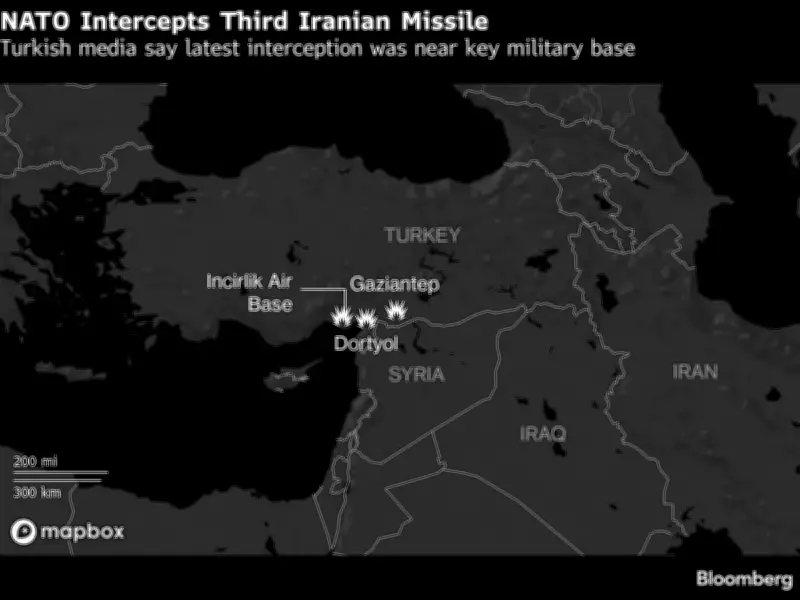
NATO Forces Intercept Third Iranian Missile Over Turkish Territory
The North Atlantic Treaty Organization successfully neutralized an Iranian ballistic missile that breached Turkish airspace on Friday, according to an official statement from Turkey's Defense Ministry. This marks the third interception of Iranian munitions targeting Turkish territory since March 4, signaling escalating regional tensions.
Strategic Base Proximity Raises Security Concerns
Turkish media reported the interception occurred in southern Adana province near the strategically vital Incirlik Air Base, a key NATO installation where the United States military maintains personnel and is believed to host nuclear weapons. The state-run Anadolu Agency confirmed that air raid sirens were activated at the base during the early morning hours, heightening security alerts.
The Defense Ministry stated: "A ballistic munition launched from Iran and entering Turkish airspace was neutralized by NATO air and missile defense assets deployed in the Eastern Mediterranean." Officials did not disclose the precise location of the interception operation.

Contrasting Narratives and Diplomatic Tensions
Iran's embassy in Ankara issued a formal denial on social media platform X, asserting that no missiles had been fired toward Turkey. The Islamic Republic expressed willingness to establish a joint investigation committee to "dispel any ambiguity" surrounding the incident.
Turkey responded by stating it was implementing all necessary defensive measures while engaging in consultations with Iranian authorities to "clarify all aspects of the incident." Anonymous sources within Turkey's security apparatus later emphasized through state broadcaster TRT that the country's measured response should not be interpreted as unlimited tolerance for such violations.
Escalating Pattern of Missile Interceptions
This latest incident represents a concerning escalation in frequency and proximity. Unlike previous interceptions over sparsely populated regions, Friday's missile approached both a major urban center and critical NATO infrastructure. The alliance has consequently reinforced its defensive posture along Turkey's southeastern border.
Earlier this week, NATO deployed additional Patriot anti-missile systems to Malatya province, home to the Kurecik radar base, another essential NATO facility. This strategic reinforcement aims to bolster air defense capabilities along the alliance's vulnerable southeastern flank.
Diplomatic Balancing Act and Regional Implications
Turkish President Recep Tayyip Erdogan recently cautioned Tehran against taking "wrong and provocative steps" that could damage bilateral relations. Despite these warnings, Ankara has deliberately avoided escalating military tensions while coordinating defensive strategies with NATO allies.
The Incirlik Air Base holds significant strategic importance, having previously served as a launch point for U.S. operations enforcing no-fly zones over northern Iraq and conducting airstrikes against Islamic State targets in Syria and Iraq. Spanish Patriot missile batteries have been stationed at the facility since 2015 as part of ongoing defense cooperation.
Iran initially denied responsibility for the March 4 missile incident before offering to form a joint investigative team following the second interception. This pattern of denial followed by diplomatic engagement complicates regional security dynamics as NATO continues to enhance its defensive capabilities in response to repeated aerial threats.