U.S. Military Buildup Near Iran Echoes Iraq Invasion, Experts Warn
The United States has amassed a vast and rapidly deployed military force in the Middle East, a move that national security experts and former Pentagon officials describe as "incredibly significant" and reminiscent of the buildup preceding the 2003 invasion of Iraq. This substantial deployment coincides with a stark ultimatum from U.S. President Donald Trump, who warned Iran to reach a deal within a maximum of 15 days or face severe consequences.
Scale and Speed Suggest Serious Intent
The American military buildup is of a scale sufficient to sustain a weeks-long air campaign. Its sheer magnitude and the swiftness of the deployment make the prospect of an offensive action appear increasingly likely. According to analysts, this mobilization surpasses even the recent U.S. military buildup in the Caribbean prior to operations targeting Venezuelan strongman Nicolás Maduro.
"This is a build-up like what we saw right before the Iraq war," stated Becca Wasser, a military strategy expert at the Center for a New American Security, emphasizing the parallels in terms of concentrated air power.

Dana Stroul, former deputy assistant secretary of defence for the Middle East, confirmed the unprecedented scale, noting, "It is an incredibly significant military build-up in a very short period of time." She added that it demonstrates "how invested Trump is in showing a tangible outcome to the current crisis" in the region.
Presidential Ultimatum and Military Movements
President Trump has framed the situation in grave terms, stating that any potential military action would be "traumatic" and exceed the severity of strikes ordered on Iranian nuclear facilities in June. "We’re either going to get a deal or it’s going to be unfortunate for them," Trump declared publicly.
Concurrent with this rhetoric, a major logistical operation is underway. Data from flight tracking services reveals that dozens of refueling tankers and heavy-lift transport aircraft have been repositioned across the Atlantic to locations nearer the potential conflict zone in just the past several days. This includes the movement of key air defence assets, such as Patriot and Thaad missile systems, from bases like Fort Hood to allied nations including Jordan.
Naval Power Concentrates in the Region
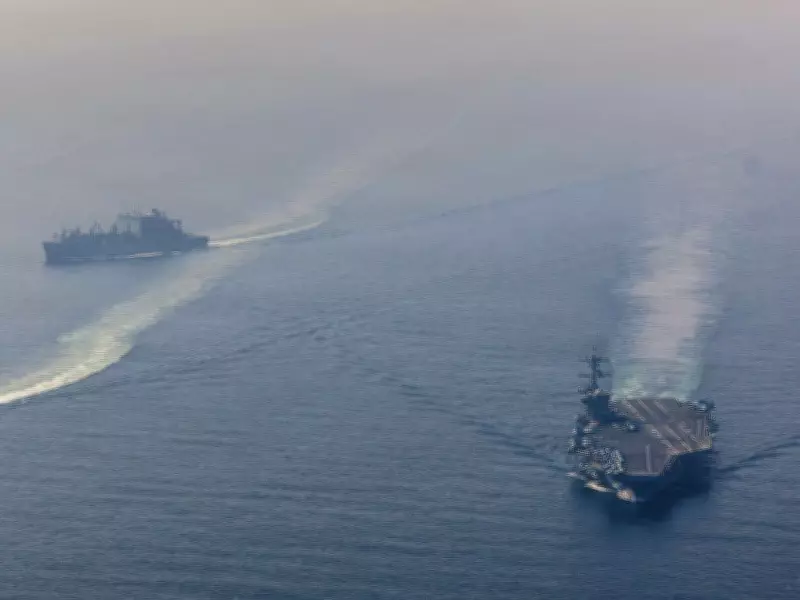
The U.S. naval presence is equally formidable and growing. Currently, at least a dozen U.S. warships are stationed in the region, including an aircraft carrier, eight guided-missile destroyers, and converted minesweepers. This force is poised to expand further with the imminent arrival of the USS Gerald R. Ford, the Navy's newest and largest aircraft carrier, accompanied by three additional destroyers.
Satellite imagery and maritime tracking data have confirmed the positions of these vessels, such as the USS Abraham Lincoln carrier group in the Arabian Sea and the Gerald R. Ford strike group transiting the African coast. Wasser notes that the deployment includes critical "enablers" like airborne early warning aircraft, solidifying the infrastructure needed for a prolonged strike campaign. This configuration transforms the buildup from mere posturing into a "very serious" and actionable threat, potentially signaling more than just diplomatic bluster.
The rapid assembly of such a comprehensive force, coupled with the president's explicit deadline, creates a tense geopolitical standoff, drawing direct and alarming comparisons to historical precedents of major military conflict.