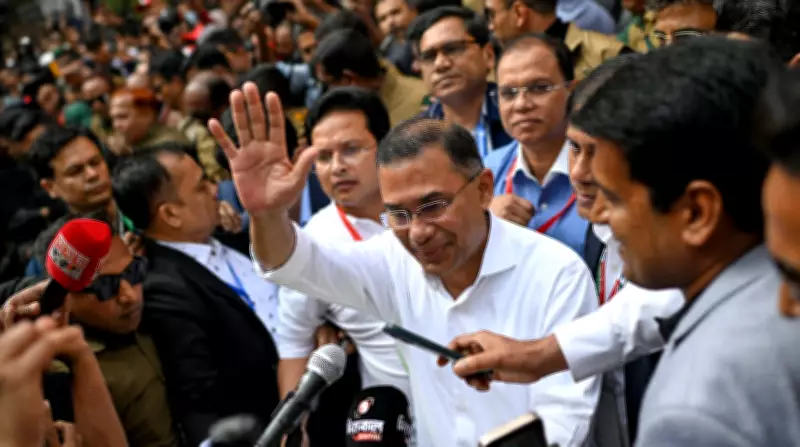
Bangladesh Nationalist Party Claims Victory in Historic Post-Uprising Election
The Bangladesh Nationalist Party (BNP) has asserted a decisive win in Bangladesh's first parliamentary election since the 2024 student-led uprising, positioning itself to form the next government and potentially redefine the nation's political trajectory after years of intense rivalry and contested electoral processes. The party's media unit announced on social media platform X this Friday that it has secured sufficient seats in Parliament to govern independently, though official results from the Election Commission are still pending. Several local media outlets have corroborated the BNP's claim of victory, adding weight to the declaration.
Leadership and International Reactions
BNP is led by Tarique Rahman, its prime ministerial candidate, who returned to Bangladesh in December after 17 years of self-exile in London. Rahman, 60, is the son of former Prime Minister Khaleda Zia, who passed away in December. In a statement, Ruhul Kabir Rizvi, senior joint secretary-general of the BNP, congratulated the people of Bangladesh on the electoral success. Separately, Saleh Shibly, press secretary to Rahman, stated that the BNP leader urged supporters to engage in special prayers during the weekly Friday service and refrain from celebratory processions.
The U.S. Embassy in Dhaka extended congratulations to Rahman and his party, labeling the win a "historic victory." U.S. Ambassador to Bangladesh Brent T Christensen expressed on X that "The United States looks forward to working with you to achieve shared goals of prosperity and security for both our countries."

Electoral Context and Opposition Concerns
The election was primarily a two-way contest between the BNP and an 11-party alliance led by the Islamist Jamaat-e-Islami, a conservative religious party whose increasing influence has raised concerns, especially among women and minority communities. Shafiqur Rahman, who leads Jamaat-e-Islami, won a seat in Dhaka and is expected to become the opposition leader in Parliament. However, his party has raised objections regarding the handling of election results.
Ahsanul Mahboob Zubair, assistant secretary-general of Jamaat-e-Islami, criticized the Election Commission for delaying results in several constituencies, describing the holdups as "unusual." In a Facebook statement, the party alleged that candidates from its alliance were "narrowly and suspiciously losing" in multiple areas, casting doubt on the electoral process.
Background and Political Significance
Thursday's vote occurred under tight security amid concerns over democratic backsliding, escalating political violence, and erosion of the rule of law. This election marked the first since the July 2024 student-led revolt that ousted former Prime Minister Sheikh Hasina, who fled to exile in India. Many viewed it as a critical test for Bangladesh's ability to restore trust in democracy and translate public protests into substantive political reforms.
For much of the past 15 years, the BNP remained in opposition, boycotting several elections and accusing Hasina's government of systematic vote rigging and political repression. Tarique Rahman himself spent 17 years in self-imposed exile after Hasina's administration pursued multiple corruption and criminal cases against him, charges he denied as politically motivated. These cases were dropped following Hasina's government's collapse, facilitating his return to Bangladesh. His campaign has portrayed him as a champion of democracy in a nation where politics have long been dominated by entrenched parties, military interventions, and allegations of electoral manipulation.
The BNP has for decades been a key component of Bangladesh's dynastic political system. Tarique Rahman's father, Ziaur Rahman, rose from military ranks to become a prominent political figure, serving as the country's sixth president until his assassination in 1981. The party was the primary rival to Hasina's now-banned Awami League, with their enduring feud shaping Bangladesh's political landscape for years.