Liberals Face High-Stakes Budget Showdown
Prime Minister Mark Carney's government is confronting a critical parliamentary test on Monday as the House of Commons prepares to vote on a controversial budget proposal. The fiscal plan, which would significantly increase borrowing to fund military upgrades and infrastructure projects, must pass to prevent Canada from plunging into another federal election just months after the last vote.
Elizabeth May's Pivotal Position
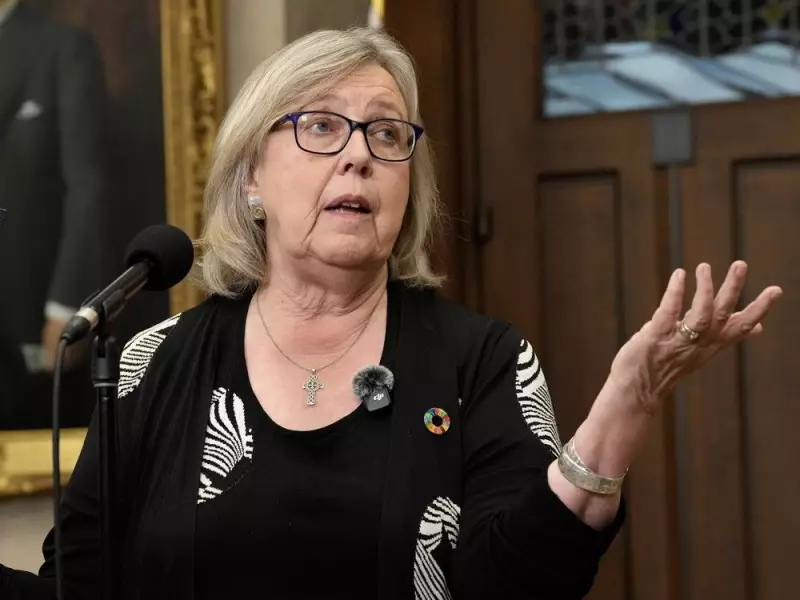
Green Party Leader Elizabeth May, who holds her party's sole seat in Parliament, has emerged as a central figure in the high-stakes drama. In a Sunday interview with CBC, May declared "right now, I'm a no" on supporting the budget. However, she indicated her position wasn't final, revealing she remained in active discussions with government officials.
"I'm in a dilemma, obviously, and I'm still talking to ministers and representatives from the prime minister's office and others to see what could we do before tomorrow afternoon to affect my vote," May told the broadcaster.

The Government's Precarious Math
The political arithmetic presents a formidable challenge for Carney's Liberals. With 170 seats in the House of Commons, the government sits two votes short of a majority. To survive the budget vote, Carney must secure either two opposition votes in favor of the fiscal plan or convince at least four opposition members to abstain.
The financial blueprint, unveiled on November 4, projects $167.3 billion in additional deficits over five years compared to previous forecasts. This substantial borrowing would fund major spending increases in defence, housing, and infrastructure projects including port expansions designed to help Canada diversify its export markets beyond the United States.
Opposition Dynamics and Election Fears
Political observers are closely watching the New Democratic Party, which holds seven seats and is currently navigating a leadership contest while managing significant debt. Many consider the NDP caucus the most likely source of support for the government in Monday's vote.
Conservative Leader Pierre Poilievre has taken a hardline stance against the budget, stating unequivocally: "One hundred percent of our members of Parliament oppose the costly Carney credit card budget that is going to drive up the cost of food, housing and living for Canadians."
The possibility of back-to-back elections looms large. Canada hasn't experienced two federal elections within twelve months since the minority governments of 1979 and 1980, when the second election was triggered by precisely this scenario—a failed budget vote.
Ministers Express Confidence Amid Uncertainty
Despite the uncertain outcome, cabinet minister Dominic LeBlanc projected confidence in comments to Radio-Canada. "No, I'm not worried. I think there are all kinds of good reasons why different members or opposition parties want the budget to be passed," LeBlanc stated.
Finance Minister Francois-Philippe Champagne made a final appeal for cross-party support on Friday, emphasizing the economic context: "It's not a time for political games, it's not the time for posturing, this is time to fight for Canada, fight together, meet the moment, elevate yourself above politics."
The political landscape remains volatile since the April election, which saw Carney's Liberals win the popular vote and the most seats amid concerns about U.S. President Donald Trump's tariffs and aggressive posture toward Canada. Current polling shows the Liberals and Conservatives in a statistical dead heat, adding further significance to Monday's outcome.