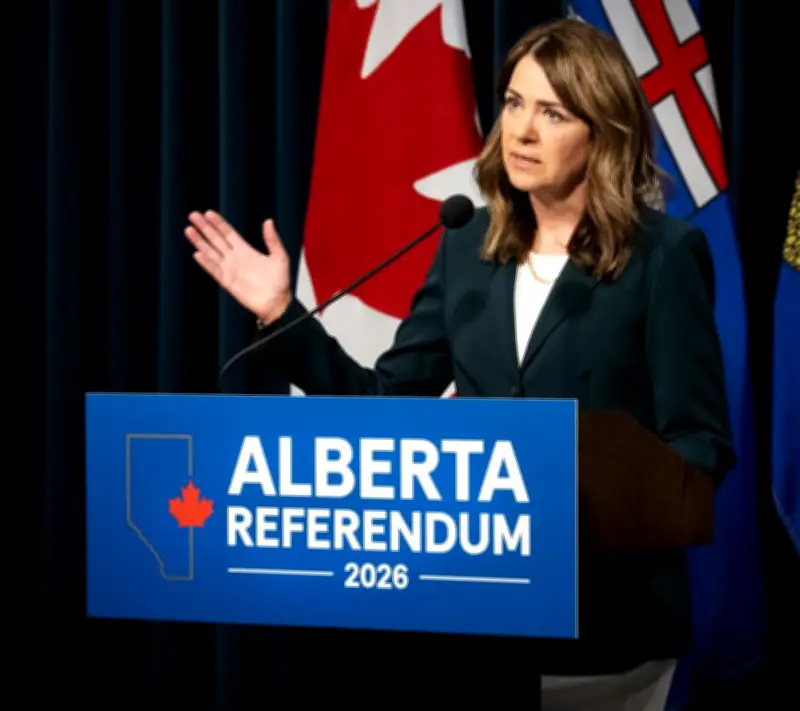
Premier Danielle Smith said Saturday that democracy is at stake in a judge's decision requiring First Nations consultation before the October 19 referendum on secession, and not fighting the decision could mean tossing out the Citizen Initiative Act enacted in 2021.
Smith defends referendum process
“The way our legislation is structured is that people should be allowed to bring a question forward, either for consideration by the legislature or for the consideration of the public as a whole, and we want to preserve that legislation, because if we allow this decision to stand, it means that we’ve got to throw our legislation out altogether, and I don’t think that’s what Albertans want,” she said on the Saturday morning radio show Your Province Your Premier.
Smith was responding to a caller named Blaine on Court of King’s Bench Justice Shaina Leonard’s decision that quashed the referendum petition, saying it neglected the UCP government’s duty to consult First Nations.

Caller questions consultation without mandate
“I understand if people want to separate, then you’re like, ‘okay, the majority of Albertans want to separate. I now have to sit down with our First Nations and consult them, because they’re a very important part of our, you know, society and everything,’” Blaine said. “But what would you consult them with without a mandate from the people?”
Smith agreed, reiterating earlier assertions of judge error, saying the decision would set a “dangerous precedent.”
Smith explains ballot question
“I think the court made a mistake, that ‘duty to consult’ is based on government action that governments are going to take. (The referendum) is a testing of the waters to see if Albertans even want us to have this question, even start the process, and so we put the remain question on the ballot, ‘Do you want to remain in Alberta?’ That’s option one, but we had to define what ‘no’ meant. You can’t just ask a question, ‘Do you want to remain in Alberta, yes or no?’ Because what if everybody votes no? What are you supposed to do next? So, what does ‘no’ mean?” Smith said.
Smith said a “no” vote would launch the legal process to hold a binding vote on separation, and she needs to get an “indication from Albertans” whether they even want to have that conversation.
Government to appeal court decision
“That’s what we put on the ballot, and we’re going to continue to fight it out in the court, because I think that it’s a very dangerous precedent to be set that people are not allowed to have a say on a democratic issue,” she said.
First Nations financial accountability
In the same program, Smith said she will talk with her ministers about stricter financial reporting among First Nations as a criteria for provincial funding. A caller named Diane asked for increased accountability among Alberta First Nations in the form of audited financial statements as a condition of provincial funding, and stronger federal enforcement of transparency requirements tying ongoing funding to the timely public disclosure of audit reports.
“Many Alberta First Nations are not publicly releasing annual financial audit reports, despite the requirement under the First Nations Financial Transparency Act, since enforcement ended in 2015 compliance has declined significantly. The lack of transparency has led to legal actions, most notably in November 2025 federal court ruling involving Frog Lake, Alberta First Nations, where approximately $120 million was reported unaccounted for, and the court affirmed community members’ rights to access financial records, setting a precedent for stronger accountability,” Diane said.