Carney-Trump War of Words Escalates as PM Strikes Nationalist Tone in Quebec
The ongoing diplomatic clash between Ottawa and Washington intensified on Thursday as Prime Minister Mark Carney delivered a strongly nationalistic speech in Quebec City. This came in direct response to former President Donald Trump's assertion that "Canada only lives because of the United States."
Carney's Defiant Response
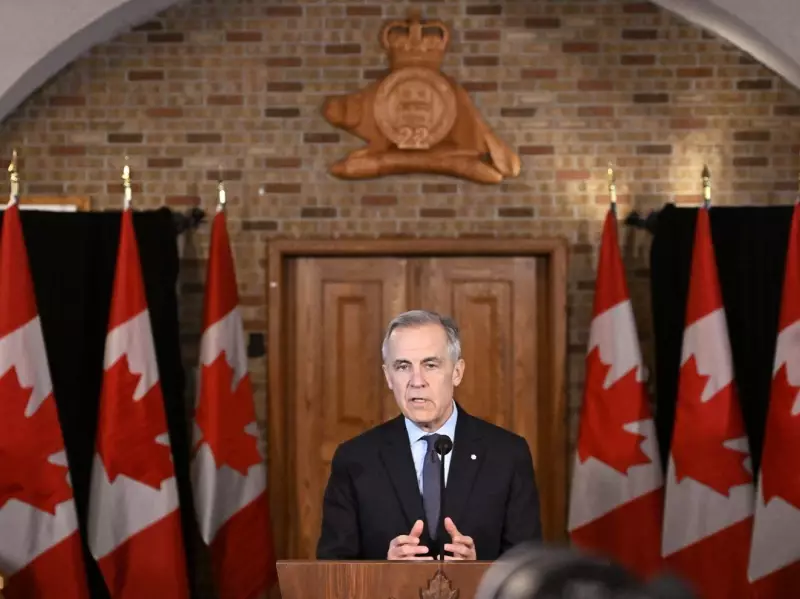
Speaking before the Liberal government's cabinet retreat at the Citadelle in Quebec City, Carney offered a pointed rebuttal to Trump's comments. "Canada doesn't live because of the United States. Canada thrives because we are Canadian," the Prime Minister declared. Notably, this line appeared to be either ad-libbed or a late addition, as it was absent from the prepared text distributed to journalists beforehand.
Carney's address took on a distinctly political and campaign-like tone, weaving historical references with contemporary critiques. He invoked the 1759 Battle of the Plains of Abraham, highlighting the convergence of British and French cultures that shaped early Canada. "In a time of rising populism and ethnic nationalism, Canada can show how diversity can be a strength, not a weakness," Carney asserted, positioning Canada as a counterpoint to global trends.

Escalating Transatlantic Tensions
The Quebec speech follows Carney's Tuesday address at the World Economic Forum in Davos, Switzerland, which contained veiled criticism of the United States under Trump. While never explicitly naming the U.S. or Trump, Carney told the international audience that "the powerful countries of the world have abandoned the rules-based order" and suggested moving beyond what he called a "facade" of international cooperation.
Trump fired back swiftly, stating: "Canada gets a lot of freebies from us. By the way, they should be grateful also, but they're not. I watched your prime minister yesterday. He wasn't so grateful." The former president added pointedly: "Canada lives because of the United States. Remember that, Mark, the next time you make your statements."
Broader American Criticism
Trump was not alone in criticizing Carney's approach. U.S. Commerce Secretary Howard Lutnick, speaking from Davos on Bloomberg Television, questioned Carney's strategic pivot toward China. "China's delighted to sell to him. But do you think China is going to open their economy to accept exports from Canada? This is the silliest thing I've ever seen," Lutnick remarked dismissively.
Lutnick further criticized Canada's position on electric vehicles and warned of potential consequences during upcoming trade negotiations. "When USMCA gets renegotiated this year... do you think the president of the United States is going to say you should keep having the second-best deal in the world?" he questioned, referencing the Canada-U.S.-Mexico Agreement (known as CUSMA in Canada).
Implications for Canada-US Relations
The exchange highlights growing strains in the bilateral relationship, with Carney adopting an increasingly assertive posture toward Canada's southern neighbor. While acknowledging Canada's significant economic benefits from proximity to the U.S., the Prime Minister's rhetoric suggests a deliberate distancing from American influence and policies.
Analysts note that Carney's nationalist framing and direct challenges to Trump's narrative represent a significant shift in diplomatic tone. The Prime Minister emphasized Canada's independent identity and global role, stating: "In a time of rising walls and thickening borders, we can demonstrate how a country can be both open and secure, welcoming and strong, principled and powerful."
As summer approaches with CUSMA renegotiations on the horizon, the escalating war of words between Ottawa and Washington suggests potentially difficult negotiations ahead. Carney's increasingly critical stance toward U.S. policies appears calculated to reinforce Canadian sovereignty while potentially complicating future trade discussions.