Pierre Poilievre Lays Out Vision for Canadian Sovereignty and Economic Strength
In a keynote address to the Economic Club of Canada in Toronto, Conservative Leader Pierre Poilievre presented a comprehensive plan to bolster Canada's sovereignty and economic resilience. The speech, delivered on Thursday, emphasized the need for Canada to focus on internal strengths amid global trade disruptions, particularly those stemming from U.S. President Donald Trump's policies.
Historical Context and Modern Challenges
Poilievre began by drawing parallels between Canada's founding principles and current geopolitical realities. He referenced Marcus Aurelius, highlighting that true strength comes from controlling one's own mind and actions, a concept he applied to national sovereignty. "Canada cannot control the decisions of foreign presidents," Poilievre stated, "but we can control the strength of our own country." He pointed to Confederation as a deliberate act of self-determination, where provinces united to build infrastructure like railways and canals, setting a precedent for proactive nation-building.
The Conservative leader criticized past complacency, noting that Canada has under-invested in its military and allowed bureaucracies to hinder resource development. He argued that this has made the country unnecessarily dependent on external forces, especially in light of China's rapid economic rise and shifting global dynamics.

Addressing U.S. Trade Volatility
Poilievre addressed President Trump's recent trade actions and comments, which he described as "wrong" and upsetting to Canadians. He emphasized that Canada's trade surplus with the U.S. results from selling high-quality resources at discounts, which American companies then resell at profit. Despite these tensions, Poilievre stressed the enduring partnership between the two nations, quoting John F. Kennedy: "Geography has made us neighbors. History has made us friends." He urged Canadians not to overreact but to adapt strategically.
The core of Poilievre's plan revolves around four pillars to make Canada "Stronger At Home" and gain leverage abroad:
- Abundant Low-Cost Energy: Eliminate carbon taxes, expedite oil, gas, and electricity projects, and remove sales tax on Canadian-made vehicles to boost affordability and autonomy.
- Unblocking Resources and Homes: Cut red tape and taxes on construction to accelerate homebuilding and resource development, using tools like Bill C-5 to fast-track approvals.
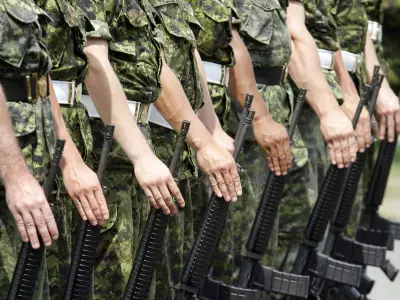
- Strong Military: Rebuild defense capabilities with faster procurement, new Arctic bases, icebreakers, and drone technologies to ensure sovereignty without reliance on others.
- Digital Sovereignty: Overhaul subsidies and tax policies to retain Canadian-developed technologies, preventing offshoring of intellectual property and securing critical systems.
Leverage in CUSMA Negotiations
Poilievre outlined how these measures would strengthen Canada's position in the upcoming CUSMA review. He proposed creating a Strategic Energy and Mineral Reserve to provide leverage in trade talks, aiming for tariff-free trade with the U.S. Specific goals include ending tariffs on steel, aluminum, autos, and lumber, establishing a Tariff-Free Auto Pact, and relaunching the Keystone XL pipeline. He also called for an All-Party CUSMA Working Group to foster cooperation while maintaining opposition scrutiny.
In closing, Poilievre asserted that sovereignty is built through decisive action and self-reliance. "Canada's destiny will never be written in Washington or Beijing," he declared, "but here at home, by Canadians." His vision aims to create an unbreakable nation that stands firm in the face of global uncertainty.