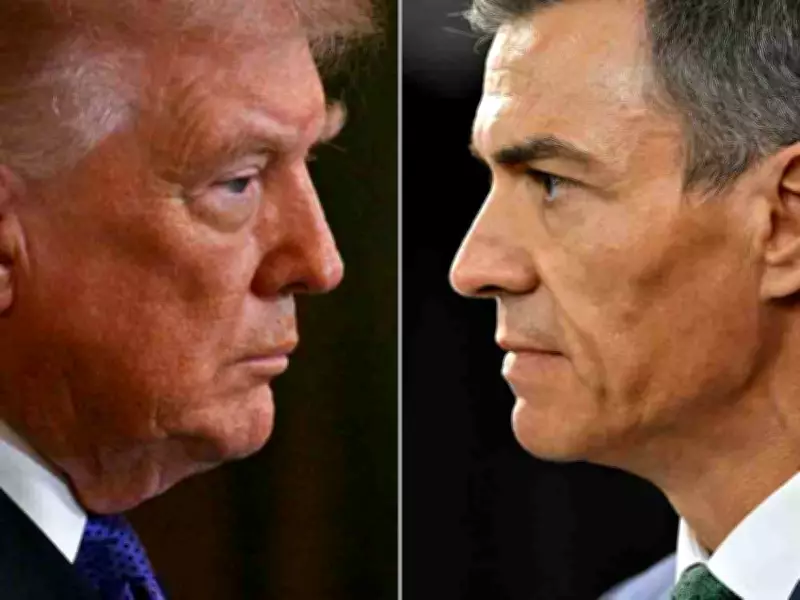
Spain's Prime Minister Takes Unprecedented Stand Against U.S. President
Spanish Prime Minister Pedro Sánchez has emerged as Donald Trump's most vocal European critic, delivering pointed rebukes that other EU leaders have avoided during escalating tensions over Iran policy. The socialist leader's willingness to directly challenge the U.S. president marks a significant departure from traditional European diplomatic approaches toward Washington.
A Direct Challenge to American Foreign Policy
During recent statements about Middle East conflicts, Sánchez issued a remarkable condemnation of U.S. actions, warning that America risked triggering "a spiral of war" through what he termed "illegal" attacks on Iran. His criticism extended beyond policy disagreements to question fundamental leadership principles, stating that politicians should improve citizens' lives rather than "use the smoke of war to hide their failures."
The Spanish leader specifically criticized what he characterized as leaders who "line the pockets of a few—the only ones who win when the world stops building hospitals to start making missiles," delivering a rare explicit critique of plutocracy and inequality from a European head of government.

Concrete Actions Beyond Rhetoric
Sánchez has backed his words with significant policy decisions, refusing to allow the United States to utilize two jointly operated military bases in Spain for strikes against Iran. This represents a substantial escalation from verbal criticism to tangible restrictions on military cooperation. Furthermore, the Spanish leader has drawn controversial parallels between current U.S.-Israeli actions and what he called the "unjust" 2003 invasion of Iraq.
These positions have positioned Sánchez as what Trump's MAGA movement considers the perfect "wokeist" target—a European leftist perceived as soft on defense, China, and migration policies. The Middle East conflict has brought simmering tensions between the two leaders to a boiling point after more than a year of growing enmity.
Economic Repercussions and Strategic Calculations
Trump has responded with economic threats, stating "We don't want anything to do with Spain" and raising the possibility of a comprehensive embargo to halt commerce between the nations. While Spanish exports to the U.S. represent only 4.6 percent of total exports—below the Eurozone average—key sectors including olive oil, wine, ceramics, electrical equipment, and machinery could face significant disruption.
Analysts question whether Sánchez has miscalculated the strategic implications of his stance. "Iran represents a miscalculation for Spain," noted Juan Luis Manfredi, senior lecturer in foreign policy at the University of Castilla-La Mancha. "The U.S. will find other ports or bases from which to launch its operations. Spain gains nothing from this equation and risks reinforcing its position as a political opponent at a particularly sensitive moment."
Diplomatic Isolation Within European Context
While other European leaders have employed various strategies in dealing with Trump—from appealing to his vanity through state visits and gifts to ideological mimicry or downplaying disagreements—Sánchez stands alone in taking direct confrontation. As the EU's most senior socialist leader, positioned to the left of even Britain's Keir Starmer, Sánchez has embraced a role that combines principled opposition with significant political risk.
The question now facing the self-declared pacifist Spanish leader is whether his approach has pushed tensions beyond productive disagreement into potentially damaging confrontation. With Trump threatening concrete economic retaliation and Sánchez maintaining his critical stance, this diplomatic clash represents one of the most significant fractures in transatlantic relations in recent years.