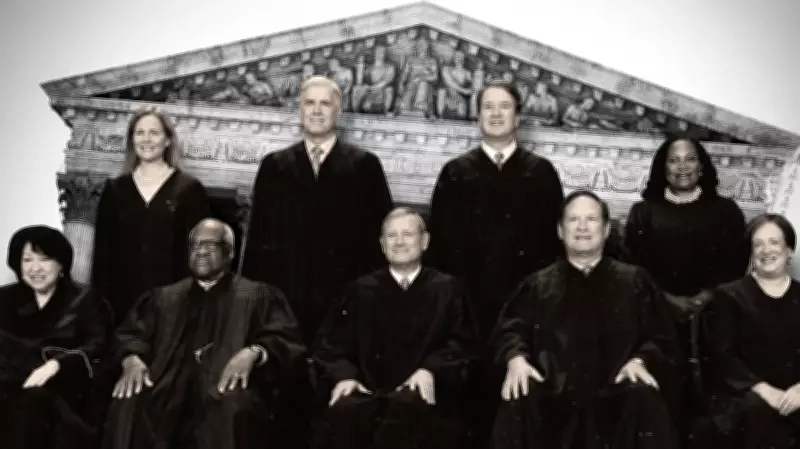
The Supreme Court dealt the landmark Voting Rights Act a significant blow on Wednesday in a 6-3 ruling that makes it far more difficult to challenge the drawing of legislative district maps as racially discriminatory.
The decision in Louisiana v. Callais, written by Justice Samuel Alito and joined by the court's other five conservatives, invalidates a Black-majority congressional district in Louisiana as an illegal racial gerrymander. While the decision does state that the Voting Rights Act can be applied to redistricting, it dramatically narrows the instances where lawmakers and courts can do so.
This decision is just the latest in an escalating series of judicial attacks on the historic civil rights law. The immediate impact is not known, but it may lead some states to challenge Black and Latino majority districts as illegal racial gerrymanders, potentially reducing their representation in legislative seats from Congress all the way down to county commissions. Since Black and Latino voters have historically preferred to elect Democrats, this would also have the effect of further tilting the House toward Republicans.

Background of the Voting Rights Act
Enacted in 1965 following the historic civil rights march from Selma, Alabama, led by the Rev. Martin Luther King Jr., the Voting Rights Act officially ended Jim Crow election schemes that prevented Black people from voting in the South. It also established legal procedures through Section 2 for citizens to challenge election laws and legislative maps as racially discriminatory and the requirement that states and municipalities with a history of racial discrimination — mostly the former Confederacy — preclear election laws and maps with the Department of Justice in Section 5. The result was a rapid expansion of minority representation in legislative bodies across the country, but particularly in the South.
Previous Court Decisions
The court's conservative justices already gutted Section 5's preclearance requirement in its 2013 Shelby v. Holder case. In 2021, they defanged the use of Section 2 as applied to election laws in Brnovich v. DNC. And now in Callais, they have turned Section 2's application for redistricting into a dead letter.
The Louisiana Case
The case arose from Louisiana's redistricting in 2021 where the state's Republican-led government largely maintained the state's existing congressional maps. Black Louisianans sued under the Voting Rights Act with a claim that the map failed to provide the state's Black population to elect representatives of their choosing by only drawing one majority-Black district. A lower court sided with the Black plaintiffs and ordered Louisiana to draw a second Black congressional district.
Meanwhile, a similar case out of Alabama, Allen v. Milligan, made its way to the Supreme Court in 2022. In a 5-4 decision written by Chief Justice John Roberts, the court ruled that Alabama must draw a second Black-majority congressional district under the Voting Rights Act. That decision also applied to the Louisiana case, which halted any further appeals by the state.
Shift in Arguments
After the state adopted a map that created a second Black-majority district and protected incumbent Republicans like Speaker Mike Johnson, a group of white Louisianans sued, claiming that the new map discriminated against white people. At first, the state argued against this challenge alongside the original Black plaintiffs. But then the Supreme Court took up the case with a brand new question: whether the Voting Rights Act's remedy for legislative maps is unconstitutional.
Louisiana suddenly switched sides to argue that the Voting Rights Act is unconstitutional. So did the Justice Department, newly under the control of President Donald Trump. This marked the first time the Justice Department argued against the Voting Rights Act.

Implications of the Ruling
Where the white Louisianans and the state argued that the Voting Rights Act's application to redistricting should be declared unconstitutional, the Justice Department argued that courts should look to the partisan motivations of state legislatures instead of any racial implications of district maps. This would mean that a map adopted purely out of partisan motive would be acceptable, even if it denied a racial minority group that opportunity to elect their chosen representatives as prescribed by the Voting Rights Act.
The court's decision did not nullify the Voting Rights Act, as many conservatives had hoped. But it does mark yet another step backward in the march for justice as the Trump administration pushes harder to undo the entirety of the Civil Rights Movement.