In a dramatic political reversal, President Donald Trump has abandoned his aggressive campaign to block legislation requiring the disclosure of investigative materials concerning his former associate Jeffrey Epstein. The sudden shift came as bipartisan support for the bill reached overwhelming levels in Congress.
From Opposition to Acquiescence
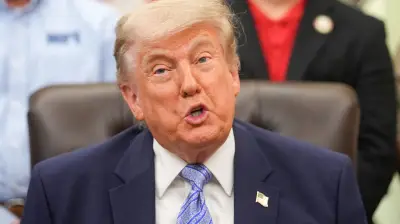
Speaking to reporters in the Oval Office on Monday, Trump declared his willingness to cooperate with the congressional effort. "They can do whatever they want. I'll give them everything," the president stated when questioned about whether he would sign the Epstein files bill if it passes both chambers.
This marked a complete turnaround from his position just days earlier, when Trump had reportedly dragged a Republican House member into the White House's most secure room, traditionally reserved for national security discussions, to pressure her into blocking the resolution.

Political Calculations Behind the Reversal
Legal experts and former administration officials view Trump's change of heart as purely political. Glenn Kirschner, a longtime former federal prosecutor, noted that the president flipped only after it became clear the legislation would pass with substantial bipartisan support.
"All you have to do is tell Attorney General Pam Bondi to release the files," Kirschner commented. "That is to cover his political ass."
Ty Cobb, who served as a lawyer in Trump's White House Counsel's Office during the first term, offered similar analysis. "Trump's most recent flip-flop on the Epstein files is his surrender to the fact he was about to be humiliated by an overwhelming vote in Congress," Cobb stated.
Contradictions and Selective Investigations
Despite his newfound cooperation with Congress, Trump continues to make claims contradicted by photographic and documentary evidence. The president repeated his assertion that he had minimal contact with Epstein, despite numerous photos showing them together at social events, including at Trump's Mar-a-Lago estate in Palm Beach, Florida, in 1997.
Simultaneously with his reversal on the files release, Trump ordered Attorney General Bondi to investigate exclusively Democrats connected to Epstein. This move prompted criticism from legal experts who view it as further evidence of the Justice Department being weaponized for political purposes.
Norm Eisen, a lawyer who served in President Barack Obama's White House, expressed concern about this development. "Donald Trump's abuse of the Department of Justice is like nothing we've ever seen before," Eisen stated.
Epstein Case Background and Ongoing Developments
Jeffrey Epstein died in an apparent suicide in 2019 while in the custody of Trump's Justice Department, just one month after his arrest on federal charges. The case gained renewed attention following a Miami Herald investigation that revealed the favorable plea deal Epstein received in 2007.
Epstein's associate, Ghislaine Maxwell, was convicted and sentenced to 20 years in federal prison under the Biden administration. However, after Trump's return to the White House, Maxwell was transferred to a minimum-security prison facility, despite Bureau of Prisons guidelines.
This transfer occurred shortly after Maxwell met with Todd Blanche, who now serves as second-in-command at the Justice Department after working as one of Trump's criminal defense lawyers. According to released transcripts, Maxwell claimed Trump and Epstein were "not close," though this assertion conflicts with evidence obtained by the House Oversight Committee.
The political drama surrounding the Epstein files continues to unfold as Congress moves forward with legislation that now appears destined for passage, forcing transparency on a case that has remained shrouded in mystery and political maneuvering.