Carney Declares End of World Order at Davos, But Foreign Policy Vision Remains Unclear
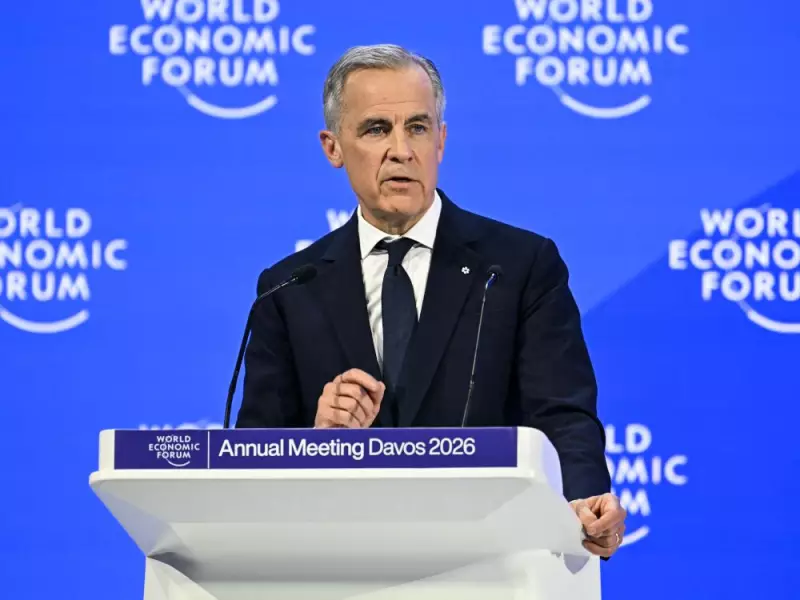
Prime Minister Mark Carney delivered a stark message at the World Economic Forum in Davos, Switzerland, this week, declaring that the global order as we know it has reached its conclusion. However, his speech left many questioning whether he has a clear vision for what should replace it or where Canada stands in this new geopolitical landscape.
Davos Address Focuses on Geopolitical Realities Over Economic Partnerships
The Prime Minister's Office had framed Carney's trip to Switzerland as an opportunity to strengthen Canada's economic partnerships and position the country as a premier destination for global investment. Yet these economic talking points comprised only a small fraction of his actual address to the international gathering.
Instead, Carney focused primarily on convincing fellow attendees that middle powers like Canada must form coalitions to assert themselves in an increasingly multi-polar world. His central argument was that nations must work together to avoid being overshadowed by global superpowers, though he notably refrained from naming specific countries like the United States or China during his remarks.

The End of the "Rules-Based International Order"
According to Carney, the international community has been operating under a false premise for decades, pretending that the rules-based international order was founded on consistently applied principles. He argued that this system has always been selectively enforced, with powerful nations exempting themselves when convenient and trade rules being applied asymmetrically.
"The story of the international rules-based order was partially false," Carney told the Davos audience. "The strongest would exempt themselves when convenient, that trade rules were enforced asymmetrically ... that international law applied with varying rigour depending on the identity of the accused or the victim."
Carney acknowledged that this system had served some useful purposes during the era of American hegemony, providing public goods like open sea lanes, financial stability, collective security, and frameworks for dispute resolution. However, he declared that "this bargain no longer works" as great powers increasingly weaponize economic integration for strategic advantage.
The Contradiction of "Value-Based Realism"
While Carney correctly identified the limitations of the current international system, his proposed alternative has drawn criticism for its internal contradictions. The Prime Minister advocates for what he terms "value-based realism," which he describes as an approach that aims to be both principled and pragmatic in foreign affairs.
Critics argue this represents a fundamental contradiction in terms, as traditional realism in international relations explicitly rejects morality as a significant factor in geopolitical calculations. From a realist perspective, power dynamics and national self-interest ultimately determine outcomes, regardless of ethical considerations.
This tension becomes particularly evident when examining Carney's approach to China. The Asian superpower represents the antithesis of Carney's vision for a principled world order, with its documented human rights violations, use of trade as a political weapon, and alignment with authoritarian regimes worldwide. Yet Carney's speech carefully avoided directly confronting these realities, leaving observers to question how his "value-based realism" would actually address such challenges.
Middle Power Cooperation as a Path Forward
Carney's central prescription for Canada's foreign policy involves increased cooperation among middle powers to ensure their voices are heard in global affairs. He argues that collaboration between nations like Canada represents the best chance for maintaining influence in a world dominated by competing superpowers.
This approach acknowledges the fundamental reality that powerful nations with substantial military capabilities and economic leverage will continue to pursue their interests regardless of international norms. As Carney noted, countries with nuclear arsenals capable of catastrophic destruction have always operated with significant latitude in the global arena.

While Carney's diagnosis of the international system's flaws appears accurate to many observers, his failure to articulate a clear, consistent foreign policy framework leaves important questions unanswered. As Canada navigates an increasingly complex global landscape, the need for coherent strategic direction becomes ever more pressing.