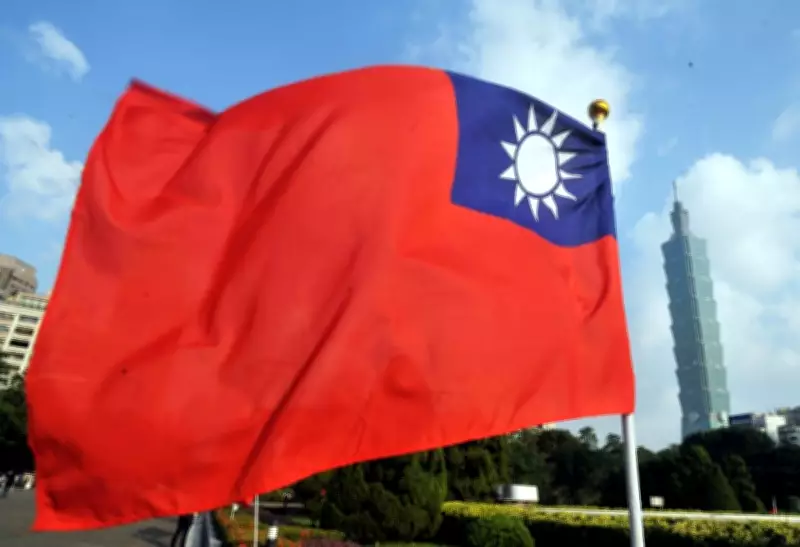
OTTAWA — As Taiwanese President Lai Ching-te begins his African state visit — a trip Beijing attempted to thwart by strong-arming world civil aviation authorities — officials suggest China's frantic opposition to such trips is an example of the communist state's growing anxiety over democratic nations having ties with Taiwan.
In an interview with the Toronto Sun, Taiwan's de facto Ambassador to Canada Harry Tseng said Lai's trip to Eswatini was an important visit to a nation that recognizes Taiwan diplomatically — a short list that does not include Canada.
"A visit to a friendly country should not be politicized," Tseng said, saying the meeting with Eswatini King Mswati III was meant to celebrate nearly 60 years of diplomatic relations with the African nation. "China should not politicize the visit of President Lai to our diplomatic allies."

Permissions to cross airspace rescinded
Late last month, the president's trip was abruptly cancelled after the Indian Ocean nations of Seychelles, Mauritius and Madagascar — which all sit along the flight path of the president's aircraft — rescinded previously granted permissions for Lai to cross their airspace. Taiwan accused China of strong-arming the nations to revoke the clearances, allegedly "weaponizing" civil aviation to intimidate Taiwan and its allies.
While Beijing denied the charges, they praised the three nations for having "high appreciation" of China — and also condemned Lai as a "rat."
Chinese envoy's interview came shortly after Sun article
About a week after the Toronto Sun's article on the cancellation, China's Ambassador to Canada Wang Di sat down with The Globe and Mail's Steven Chase, where the ambassador issued stark warnings concerning Canada's friendly relations with Taiwan. "If these parliamentarians conduct any official engagement with the Taiwan side, that will be hurtful … any official engagement between China and Canada should only happen between the People's Republic of China and Canada," Wang told the newspaper. "Sending warships through the Taiwan Strait and doing harassment and even provocation, of course, that is in violation of the One China principle and that also violates China's territorial integrity."
Beijing's One China policy dismisses Taiwan's sovereignty, describing the island nation as a renegade state and maintains it as an immutable part of China. After China's nationalist government fell to the communist revolution in 1949, nearly two million civilians, troops and officials of Chiang Kai-shek's Kuomintang government fled to Taiwan to establish the "Republic of China" — Taiwan's official designation. Wang also warned that Canada's renewed relations with the communist superpower could be "damaged" if MPs continue to visit Taiwan.
Taiwan makes Beijing nervous, Tseng said
Canadian warships periodically participate in transits of the Taiwan Strait as a freedom-of-navigation exercise, most recently in September when the HMCS Ville de Quebec and Australian destroyer HMAS Brisbane sailed the disputed waters. To the chagrin of neighbouring nations, China has embarked on an increasingly belligerent campaign of construction and militarization of artificial islands in the South China Sea, summarily claiming large swaths of the strategic waters and harassing civilian fishing vessels from Vietnam and the Philippines for operating within their own sovereign waters.
Tseng said diplomatic nations need to stand together to condemn China's actions. "Intimidating democracies reveals China's growing anxiety," Tseng said, adding he hopes parliamentarians won't be swayed from aligning with or visiting Taiwan — particularly in light of Canada's renewed relations with China and Canada's reimagined Indo-Pacific strategy. "There's no better way than visiting Taiwan to understand the geopolitical situation in that part of the world."
Ceding foreign policy to Beijing?
Former MP Kevin Vuong, himself a victim of Chinese foreign interference, said Canada needs to tread carefully concerning threats from China's communist government. "The Chinese ambassador has given the Canadian government no choice but to send MPs to Taiwan and transit the strait, as anything less would be confirmation they have ceded Canada's foreign policy to be dictated by a foreign authoritarian government," he told the Sun.

Deputy Conservative leader Melissa Lantsman, who visited Taiwan in January, dismissed Wang's warnings and said warnings from Canada's intelligence agencies about Chinese meddling speak for themselves. "Pulling Liberal MPs from Taiwan in January, right before Mark Carney's flight to Beijing, wasn't diplomacy, it was a signal that pressure from Beijing gets results," she said in an interview. "Canada does not take its instructions from foreign ambassadors — the prime minister should make that clear."