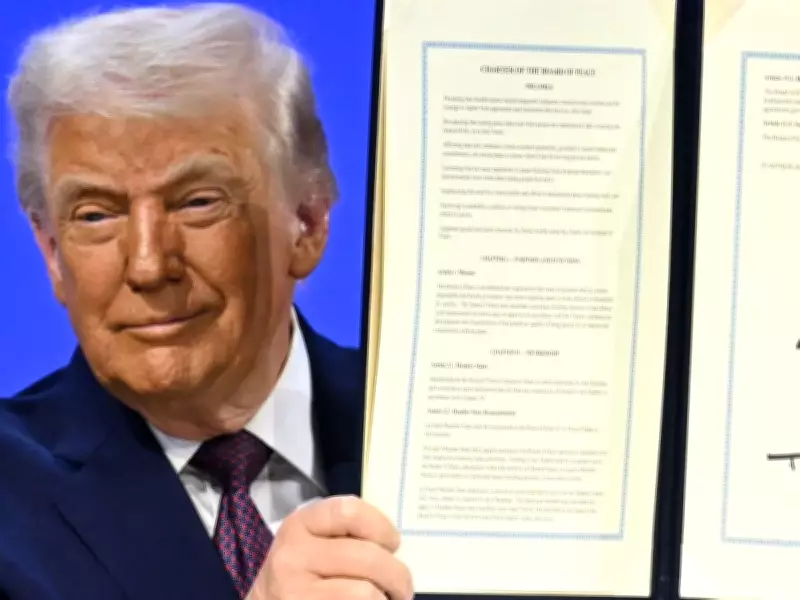
Trump Chairs First Board of Peace Meeting on Gaza with Over 40 Nations Attending
U.S. President Donald Trump presided over the inaugural meeting of the Board of Peace in Washington on Thursday morning, where officials gathered to discuss Phase 2 of his comprehensive Gaza plan. This high-profile summit marks a significant step in international efforts to address the ongoing situation in the region.
International Participation and Observers
More than 40 countries, along with the European Union, have confirmed their attendance at Thursday's inaugural meeting, according to an unnamed senior official in the Trump administration who spoke with the Associated Press. However, the official noted that more than a dozen nations—including Germany, Italy, Norway, and Switzerland—are expected to attend as observers rather than full participants, having declined Trump's invitation to formally join the Board of Peace.
Key Speakers and Participants
The summit featured prominent speakers including Secretary of State Marco Rubio, Special Envoy Steve Witkoff, Ambassador to the U.N. Mike Waltz, Trump's son-in-law Jared Kushner, former British Prime Minister Tony Blair, and the Board of Peace's high representative for Gaza, Nickolay Mladenov. This diverse lineup underscores the broad international interest in the Gaza peace initiative.

Gaza Reconstruction and Governance Plans
Updates were expected from the Gaza Executive Board, which serves as the crucial link between the Board of Peace and the National Committee for the Administration of Gaza (NCAG). This transitional Palestinian body is envisioned by Washington to enter Gaza and replace Hamas's rule. The Executive Board will detail efforts to establish a governing system and essential services for Gaza, as explained by the anonymous U.S. official to the Associated Press.
Trump announced on Sunday that Board members have pledged more than $5 billion toward Gaza humanitarian and reconstruction efforts. Additionally, they have committed thousands of personnel to the International Stabilization Force and local police units scheduled for deployment to the Strip under his peace plan.
Demilitarization as a Critical Precondition
Trump emphasized that Hamas terrorists must uphold their "commitment to full and immediate demilitarization" for the peace plan to proceed. This condition has become increasingly contentious, as several top Hamas leaders—including Khaled Mashaal and Musa Abu Marzouk—have rejected key parts of the peace plan in recent weeks, particularly disarmament, despite having agreed to it in October 2025.
Nickolay Mladenov reinforced this point on February 13, stating that the disarmament of Hamas and all other Palestinian terrorist groups is an essential precondition for Gaza's reconstruction. Speaking during a panel discussion at the annual Munich Security Conference, Mladenov explained, "Gaza needs to be governed by a transitional authority, as authorized by Security Council Resolution 2803, under which it needs to take on the full civilian and security control of Gaza."
Warnings and Challenges Ahead
Mladenov issued a stark warning to attendees: "If Gaza returns to war, there's no place for the Board of Peace—there's no place for any of us, until we see what is left and potentially pick up the rubble at the end of it." This statement highlights the fragile nature of the peace process and the high stakes involved.
Complicating matters further, Hamas terrorists are reportedly strengthening their hold over the Gaza Strip by placing loyalists in government roles, collecting taxes, and paying salaries, according to Israeli intelligence reviewed by Reuters on Thursday. This development suggests ongoing resistance to the transitional authority envisioned by the Board of Peace plan.
The meeting represents a critical juncture in international diplomacy regarding Gaza, balancing ambitious reconstruction goals with the practical challenges of demilitarization and governance transition.