Welcome to the era of the 'Donroe Doctrine' — a modern reinterpretation of a nearly 200-year-old U.S. foreign policy principle now being used to justify military intervention in Venezuela and assert American dominance across the Americas.
The State Department's Stark Declaration
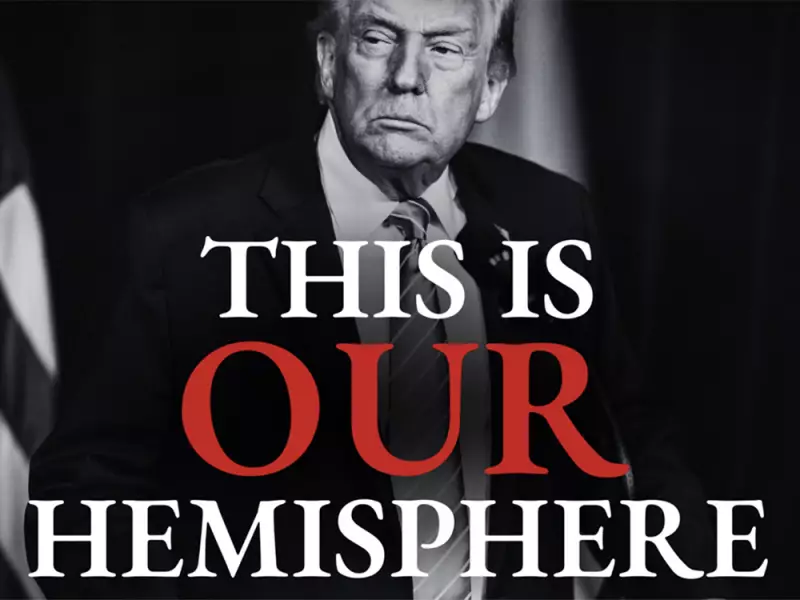
The shift in policy was signaled clearly on January 5, 2026, when the U.S. Department of State posted a bold message on the social media platform X. The post stated, 'This is OUR Hemisphere, and President Trump will not allow our security to be threatened.' It was accompanied by an image of President Donald Trump with the text 'THIS IS OUR HEMISPHERE' overlaid.
This declaration followed a major military operation. Two days earlier, on January 3, President Trump announced at a press conference held at his Mar-a-Lago estate that U.S. forces had captured Venezuelan President Nicolás Maduro and his wife, Cilia Flores. The couple faces drug trafficking and weapons charges in a New York court, where they pleaded not guilty in their first appearance on Monday. Maduro has declared himself a prisoner of war.

President Trump stated that the United States would administer Venezuela until 'a safe, proper and judicious transition' is possible. This action has thrust the Monroe Doctrine, a cornerstone of 19th-century American foreign policy, back into the contemporary geopolitical spotlight.
What is the Monroe Doctrine?
The origins of the Monroe Doctrine trace back to December 2, 1823, when the fifth U.S. president, James Monroe, delivered a historic address to Congress. In his speech, Monroe warned European powers against any further colonization or intervention in the newly independent nations of Central and South America.
'As a principle in which the rights and interests of the United States are involved, the American continents, by the free and independent condition which they have assumed and maintained, are henceforth not to be considered as subjects for colonization by any European powers,' Monroe declared.
This address evolved into the Monroe Doctrine, a framework that has been invoked by numerous presidents throughout history, including Theodore Roosevelt (who added the Roosevelt Corollary), Ronald Reagan, and John F. Kennedy. Its core concept established two distinct spheres of influence: the Americas for the United States, and Europe for the European powers.
According to the U.S. Office of the Historian, the doctrine meant 'The independent lands of the Western Hemisphere would be solely the United States’ domain. In exchange, the United States pledged to avoid involvement in the political affairs of Europe... and not to interfere in the existing European colonies already in the Americas.'
A Doctrine Reborn and Its Hemispheric Reckoning
The doctrine's reinterpretation has historically played a role in other U.S. interventions in Latin America, such as in the Dominican Republic and Nicaragua during the 20th century. Its latest application in Venezuela demonstrates its enduring influence on Washington's relationships with its southern neighbors.
American historian Anne Applebaum notes that a vision of dividing the globe into spheres of influence has resonated within the Trump administration. This worldview suggests 'The U.S. would control the Western hemisphere, China would control Asia, Russia would control Europe.'
The capture of Maduro and the invocation of the Monroe Doctrine, now colloquially dubbed the 'Donroe Doctrine' by observers, marks a significant and aggressive reassertion of this hemispheric authority. It signals a potential reckoning for the balance of power and diplomatic relations across North and South America, setting a precedent for how the United States may engage with the region in the years to come.