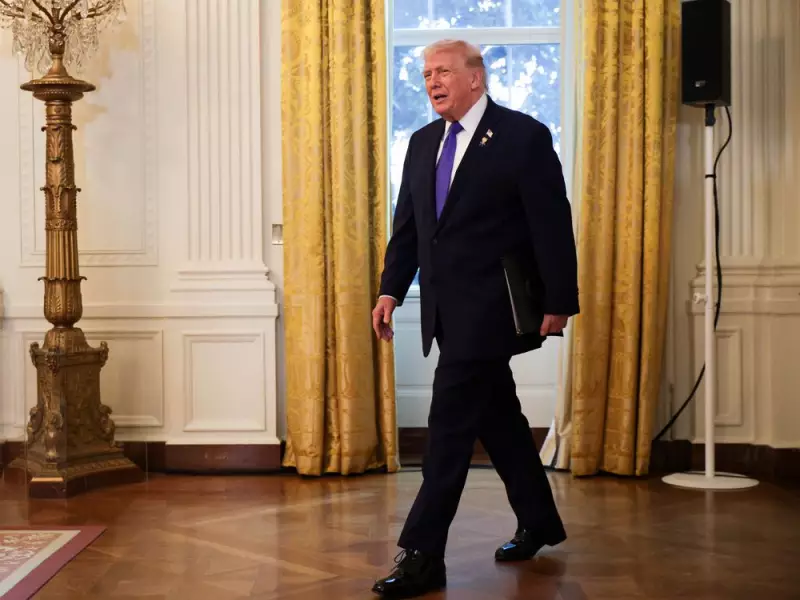
In a stark commentary for the Financial Post, veteran financier and commentator Thomas S. Caldwell issues a sobering warning to Canada: do not underestimate the imperial ambitions of U.S. President Donald Trump. Published on January 9, 2026, Caldwell's analysis argues that the American leader, unbound by historical conventions or respect for other nations, represents a unique threat to Canadian sovereignty and security.
Historical Echoes and a New Axis of Power
Caldwell begins with a potent historical analogy, referencing the Anschluss—the 1938 annexation of Austria by Nazi Germany. He notes that such territorial ambitions, often justified by shared language or "artificial" borders, are a root cause of conflict. Today, he contends, we are in a world where old alliances and laws are crumbling, even within the United States itself.
The columnist observes that President Trump now operates as an unfettered ruler in his own eyes, viewing the world through a tripolar lens dominated by himself, Russia's Vladimir Putin, and China's Xi Jinping. This dynamic, Caldwell suggests, forms a new "axis of power" where each leader seeks total influence within their sphere.

The "National Security" Pretext and Direct Threats to Canada
A central theme in Caldwell's warning is the weaponization of the phrase "national security." He traces its origins to the Stalinist era and its modern use as a catch-all pretext for action. This, he argues, is highly relevant for Canada.
Caldwell points to several alarming indicators. He recalls Trump's past allegations of a "flood" of drugs and illegal immigrants entering the U.S. from Canada—claims repeated often enough to become a perceived truth for some. More concretely, he highlights the United States' expressed desire to annex Greenland, despite objections from NATO ally Denmark, citing Greenland's resources under the guise of security.
The analysis turns directly to Canadian vulnerability. Caldwell acknowledges the validity of U.S. claims that Canada cannot adequately defend its vast Arctic coastline. The critical question he poses is: defend it from whom? The threat, he implies, could as easily emanate from the south as from Russia or China.
Canada's Geographic and Military Vulnerability
The columnist delivers a blunt assessment of Canada's defensive posture. Noting that the nation's economic heartland lies within a narrow, 150-mile strip north of the U.S. border, he states that the country is effectively indefensible with its current military capabilities. His grim analogy: Canada could just as effectively post reduced speed limits to slow a southern incursion.
A Call for Seriousness and Vigilance
Thomas S. Caldwell's conclusion is unambiguous. President Trump, embracing a self-appointed imperial role, feels constrained by neither rules nor respect for other nations. For Canada, this reality cannot be dismissed or downplayed. The combination of a powerful neighbor with expansive ambitions and a Canada physically and militarily exposed creates a precarious situation.
The article serves as a call for Canadians and their government to view the evolving geopolitical landscape with clear eyes. In a world where historical precedent is being discarded, Caldwell urges serious consideration of what Trump's next move might be—and how Canada must prepare to protect its future and sovereignty.