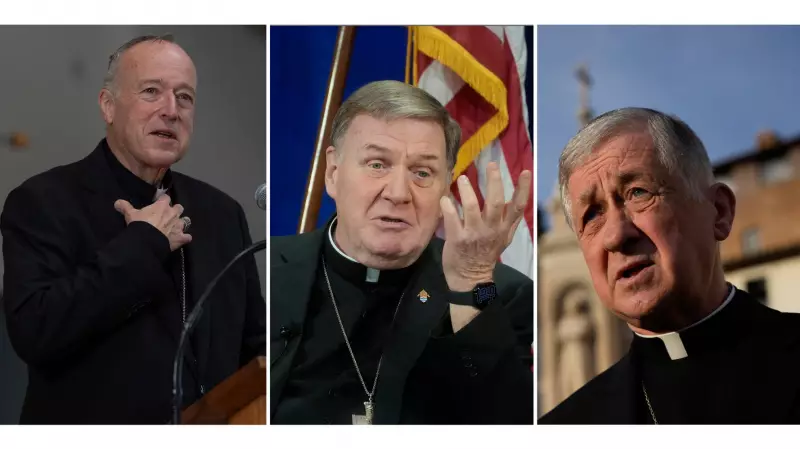
Three leading American Catholic cardinals issued a powerful joint statement on Monday, calling on the Trump administration to guide its foreign policy with a stronger moral compass. They warned that recent actions, including military intervention in Venezuela, threats to acquire Greenland, and significant reductions in foreign aid, risk causing immense suffering rather than fostering global peace.
A Call for Ethical Leadership in Global Affairs
Cardinals Blase Cupich of Chicago, Robert McElroy of Washington, and Joseph Tobin of Newark, New Jersey, argued that the current debate over Washington's role in the world is trapped in "polarization, partisanship, and narrow economic and social interests." Without a clear moral vision, they contend, the United States forfeits its potential to be a force for good.
"Most of the United States and the world are adrift morally in terms of foreign policy," Cardinal McElroy stated in an interview with The Associated Press. "I still believe the United States has a tremendous impact upon the world."

This public stance is notable, marking the second time in recent months that high-ranking U.S. Catholic leaders have openly challenged a Trump administration they believe is failing to uphold fundamental principles of human dignity. In November, the entire U.S. Conference of Catholic Bishops condemned the administration's mass deportation practices and its harsh rhetoric toward migrants.
Drawing Guidance from the Pope's Critique
The three cardinals, who are influential voices in the more progressive wing of the American church, anchored their statement in a major foreign policy address delivered by Pope Leo XIV on January 9. Speaking to diplomats at the Vatican, the first U.S.-born pope delivered a substantial critique, delivered almost entirely in English, of how nations use force to assert dominance.
While not naming specific countries, Pope Leo denounced actions that "completely undermine" peace and the international legal order established after World War II. His speech coincided with global tensions, including the U.S. military operation in Venezuela aimed at ousting Nicolás Maduro, public U.S. interest in purchasing Greenland, and Russia's ongoing war in Ukraine.
The U.S. Conference of Catholic Bishops was consulted on the cardinals' statement. Its president, Archbishop Paul Coakley, "supports the emphasis placed by the cardinals on Pope Leo’s teaching in these times," according to spokesperson Chieko Noguchi.
Questioning Force and Championing Human Dignity
In their document, the cardinals explicitly pointed to Venezuela, Greenland, and Ukraine as examples that "raised basic questions about the use of military force and the meaning of peace." They also highlighted the deep cuts to foreign aid initiated by the Trump administration last year.
"We renounce war as an instrument for narrow national interests and proclaim that military action must be seen only as a last resort in extreme situations, not a normal instrument of national policy," they wrote. Their vision is for a foreign policy that respects human life, religious liberty, and human dignity worldwide, actively supported through economic assistance.
Cardinal Tobin elaborated on the needed ethical framework: "It can’t be that my prosperity is predicated on inhuman treatment of others. The real argument isn’t just my right or individual rights, but what is the common good."
Cardinal Cupich acknowledged that removing Maduro could be viewed as a positive goal, but strongly objected to the method of a U.S. military incursion into a sovereign nation. "When we go ahead and do it in such a way that is portrayed as saying, 'Because we can do it, we’re going to do it, that might makes right' — that’s a troublesome development. There’s the rule of law that should be followed," he told the AP.

The cardinals emphasized that their primary goal was not mere criticism, but to encourage the United States to reclaim its moral standing by pursuing an ethically-guided foreign policy focused on the common good. "We’re not endorsing a political party or a political movement," Tobin clarified, urging all people of good will to advocate for basic human decency.
The White House did not immediately respond to a request for comment on the statement.