A diplomatic tussle between the United States and Spain over the war in Iran intensified on Wednesday, with the governments exchanging contradictory statements regarding the potential use of Spanish military bases by American armed forces for Middle East operations. This clash highlights growing tensions between the two allies amid escalating conflict in the region.
Conflicting Statements on Base Access
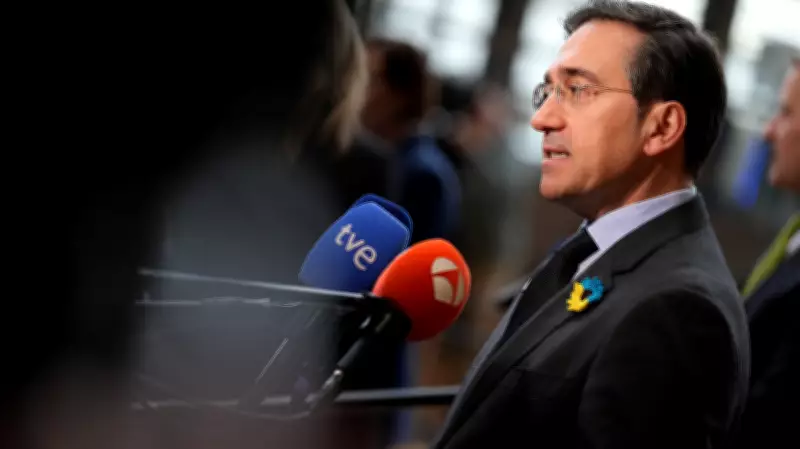
Moments after a White House spokesperson asserted that the Spanish government in Madrid had agreed to assist the U.S., Spanish Foreign Minister José Manuel Albares publicly refuted the claim. Albares told Spanish radio station Cadena Ser that the position of the Spanish government regarding the war in the Middle East, the bombing of Iran, and the use of its bases had not changed "one iota." This direct denial came shortly after White House press secretary Karoline Leavitt stated that Spain had heard President Donald Trump's message "loud and clear" and agreed to cooperate with the U.S. military.
Background of the Disagreement
The disagreement erupted on Tuesday when President Trump threatened to cut off all trade with Spain, following Spanish Prime Minister Pedro Sánchez's declaration that his government would not "be complicit in something that is bad for the world." Albares had previously stated that Spain would not allow the U.S. to use jointly operated bases in southern Spain, such as Rota and Morón, for strikes not covered by the U.N. charter. In response, Trump claimed, "We could just fly in and use it," though he added, "we don't have to."

Spanish Criticism and Firm Stance
Hours before Leavitt's comments, Prime Minister Sánchez reiterated his criticism of U.S. and Israeli military actions in Iran, warning that the war risked "playing Russian roulette" with millions of lives. In a televised address, Sánchez emphasized that Spain would not compromise its values and interests out of fear of reprisals, calling the attacks "unjustifiable" and "dangerous." He summarized the government's position as "No to the war," expressing concerns that the conflict could lead to another costly military quagmire similar to past interventions in Iraq and Afghanistan.
U.S. Response and Trade Threats
U.S. Treasury Secretary Scott Bessent, in an interview with CNBC, suggested that a trade embargo with Spain would be a "combination effort," though he provided no further details. He accused Spain of endangering American lives by refusing base access, stating that anything slowing down the war effort "puts American lives at risk." However, it remains unclear how Trump would implement a trade cutoff, as Spain is a member of the European Union, which negotiates trade on behalf of its 27 member states.
Economic Implications and EU Solidarity
Spain's main business groups, including CEOE, CEPYME, and ATA, expressed concerns over the trade threats, describing the U.S. as a "key partner from an economic and political standpoint." They expressed hope that trade relations would remain unaffected. According to a report from Spain's central bank, the country's exports and imports with the U.S. account for 4.4% of its GDP, compared to 10.1% for the EU as a whole. Key exports to the U.S. include pharmaceutical products, olive oil, refined gas, and electrical transformers.
The European Union affirmed its solidarity with member states, with European Commission spokesperson Olof Gill stating that the EU would protect its interests and work to stabilize trade relations with the U.S., following a trade deal struck last year after months of uncertainty over Trump's tariffs.
Broader Context of U.S.-Spain Relations
This incident marks the latest flare-up in Spain's relationship with the Trump administration. Sánchez has been an outspoken critic of the Israel-Hamas war in Gaza and previously attracted Trump's ire when Spain backed out of NATO's pledge to increase defense spending to 5% of GDP, opting for 2.1% instead. Trump had threatened tariffs in response, highlighting a pattern of using trade as a punitive tool, despite recent Supreme Court rulings limiting his tariff powers.
As the diplomatic standoff continues, both nations face challenges in balancing military cooperation with political principles, with potential repercussions for transatlantic alliances and global stability.