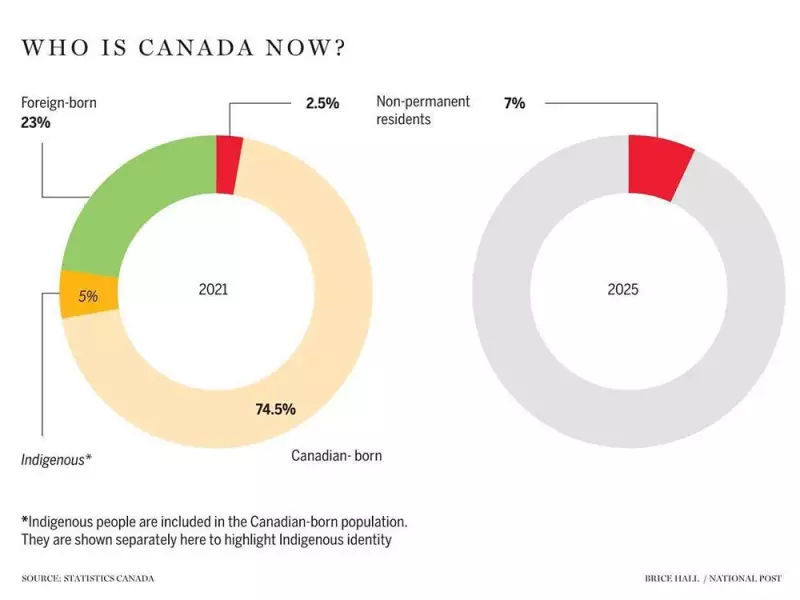
A profound and generational shift in Canada's attitude toward immigration crystallized in late 2025, moving the national conversation from one of open acceptance to one of stark calculation. The turning point became starkly visible around November 2025, when Canada's population, after years of rapid growth, peaked and began a notable decline.
The Policy Pendulum Swings
This new reality was formalized in the federal budget of November 2025, which aggressively doubled down on a dramatic policy reversal. The government slashed the cap on temporary residents from 675,000 to 385,000. This move followed a period of massive spikes during the pandemic, a strategy initially intended to stimulate the economy but which later was acknowledged to have placed immense strain on housing and core services.
The budget came alongside sobering demographic news: Canada's population of approximately 41.5 million people fell by 76,000 in a single quarter. This represented the largest quarterly drop since the 1940s, signaling that a moment of major flux had ended. The government's goal is now to reduce the percentage of temporary residents from a peak of 7.5% in 2024 back down to 5%, or one in twenty people. Furthermore, new permanent residents are to be kept under 1% of the population by 2027.

A Sea Change in Public Sentiment
This policy tightening aligns with a seismic shift in Canadian public opinion. For decades, since the 1990s, attitudes toward immigration remained broadly positive. However, polling by Environics now shows a clear majority of Canadians believe "there is too much immigration to Canada." In late 2024, this view was held by 58% of Canadians—a striking 14-point increase from the previous year.
Professor Rupa Banerjee of Toronto Metropolitan University, who holds the Canada Research Chair in Economic Inclusion, Employment and Entrepreneurship of Canada’s Immigrants, notes the change. "For the first time in 25 years we started seeing the public move against immigration," Banerjee said. She explained that the post-pandemic surge in temporary residents, including foreign students and workers, became a "flashpoint" for broader national frustrations, even if it was an oversimplification of complex issues.
The New Normal: A "Ruthless" Calculus
Prime Minister Mark Carney framed the 2025 budget as a move to get immigration "under control," an unspoken admission that it had not been managed effectively in the recent past. The popular middle ground on immigration is no longer an emotionally driven appeal to Canada's historic virtues as a welcoming nation. It has been replaced by a more restrained, calculating, and some might say ruthless, view of immigration strictly through the lenses of economic necessity and demographic sustainability.
The pieces of the national policy kaleidoscope have settled into a new pattern. The cuts to immigration levels are not a temporary correction but are expected to accelerate in the coming years. For a growing number of Canadians, immigration is now broadly perceived as a problem to be managed, rather than the unequivocal solution to the country's demographic and economic challenges it was once considered to be.