Reuters Investigation Uncovers Pattern of Misleading Statements by Trump Administration Immigration Officials
A comprehensive Reuters review has revealed a troubling pattern within the Trump administration's immigration enforcement apparatus. Top officials from the Department of Homeland Security and related agencies have repeatedly issued statements about violent encounters involving federal agents that were later contradicted by video evidence, court documents, and medical examiner reports.
Contradictions Emerge in Multiple Incidents
The investigation examined six separate incidents across Minneapolis, Chicago, and Texas that collectively demonstrate a concerning trend. In each case, immigration officials rushed to defend their officers' actions without waiting for key facts to emerge, often presenting narratives that subsequent evidence disproved.
Former immigration officials interviewed by Reuters described this approach as a clear departure from past practices, where federal agencies typically exercised more caution in their public statements during ongoing investigations.

Minneapolis Shooting Cases Show Pattern
Two fatal shootings in Minneapolis this month illustrate the pattern particularly clearly. After Border Patrol agents shot and killed 37-year-old Alex Pretti on January 24, DHS officials claimed he had approached officers with a 9mm semi-automatic handgun. White House aide Stephen Miller went further, calling Pretti a "domestic terrorist" and "would-be assassin" on social media.
However, video evidence verified by Reuters told a different story. The footage showed Pretti holding a cell phone, not a firearm, as agents wrestled him to the ground. The video also revealed that an officer removed Pretti's legally permitted weapon from his body shortly before the shooting began.
Vehicle Incident Narrative Unravels
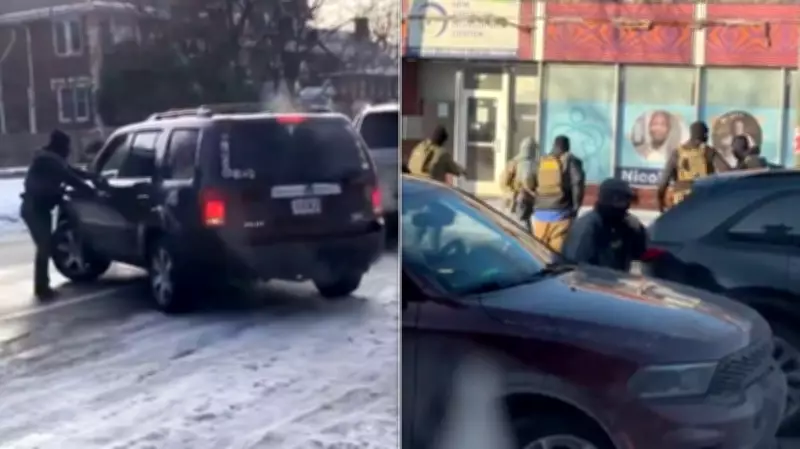
Similarly, after ICE officers shot and killed 37-year-old Renee Good in Minneapolis on January 7, DHS described her as a "violent rioter" who had "weaponized her vehicle" in an attempt to run over law enforcement officers. President Trump himself claimed Good "ran over the ICE officer" who shot her in self-defense.
Multiple videos from different angles contradicted these accounts. The footage showed Good's vehicle partially blocking a street as agents approached. One agent positioned himself near the front of her car while another stood by the driver-side window. As the car moved forward with its wheels turned away from the agent, he drew his weapon and fired three shots, killing Good.
Mistaken Identity Case Revealed
In another Minneapolis incident on January 15, DHS claimed officers were conducting a targeted traffic stop for Venezuelan immigrant Julio Sosa-Celis when he fled, crashed his car, and then assaulted an ICE officer with a snow shovel and broom handle, prompting the shooting.
Court documents unsealed last week revealed a different reality. An FBI affidavit indicated that ICE officers had scanned a license plate registered to a different person suspected of immigration violations, leading them to chase the wrong vehicle. The actual driver was another Venezuelan immigrant who crashed and fled to an apartment building where Sosa-Celis happened to be present.
Detention Death Ruled Homicide
The investigation also examined the death of Cuban immigrant Geraldo Lunas Campos in a Texas detention center on January 3. ICE initially announced he had experienced "medical distress" and that the incident was under investigation.
After a Washington Post report indicated the El Paso County medical examiner was likely to rule the death a homicide, DHS issued a new statement claiming Lunas had attempted suicide and then resisted security officers. The medical examiner's report ultimately confirmed the death was a homicide due to asphyxia from neck and torso compression.
Judicial Criticism of Government Accounts
Federal judges have taken note of these discrepancies. In a November opinion restricting immigration agents' use of force in Chicago, U.S. District Court Judge Sara Ellis wrote that the government's "widespread misrepresentations call into question everything that defendants say they are doing in their characterization" of enforcement operations.

Judge Ellis specifically cited an instance where Border Patrol commander Gregory Bovino initially claimed a rock had hit him in the head during a protest, only to later admit in court that it had "almost hit" him. She noted that "every minor inconsistency adds up, and at some point, it becomes difficult, if not impossible, to believe almost anything" the government said.
Case Dismissal After Evidence Contradiction
The pattern extended to a Chicago-area case where DHS claimed a woman had "rammed" law enforcement officers while "armed with a semi-automatic weapon." U.S. citizen Marimar Martinez was shot five times by an agent and faced federal charges.
Her attorney presented bodycam footage contradicting the DHS account, showing Martinez had left her gun in her purse and never brandished it. The government eventually dropped the case, citing "new facts and information" from their review.
Former Official Questions Motives
David Lapan, who served as DHS press secretary in 2017 during Trump's first administration, expressed concern about the pattern. "They are trying to control a narrative from the very start, and they don't seem to care when they're proven wrong," he told Reuters.
DHS Defends Its Approach
In response to Reuters' inquiries, DHS pointed to previous statements about incidents involving their officers and emphasized the need for officer safety during what they described as Trump's immigration crackdown. Spokesperson Tricia McLaughlin stated, "We have seen a highly coordinated campaign of violence against our law enforcement," adding that the department aims to "give swift, accurate information to the American people."
White House press secretary Karoline Leavitt maintained that President Trump "wants to let the investigation continue and let the facts lead."
The Reuters investigation raises significant questions about transparency and accountability within federal immigration enforcement agencies, particularly as they implement increasingly aggressive policies under the current administration.