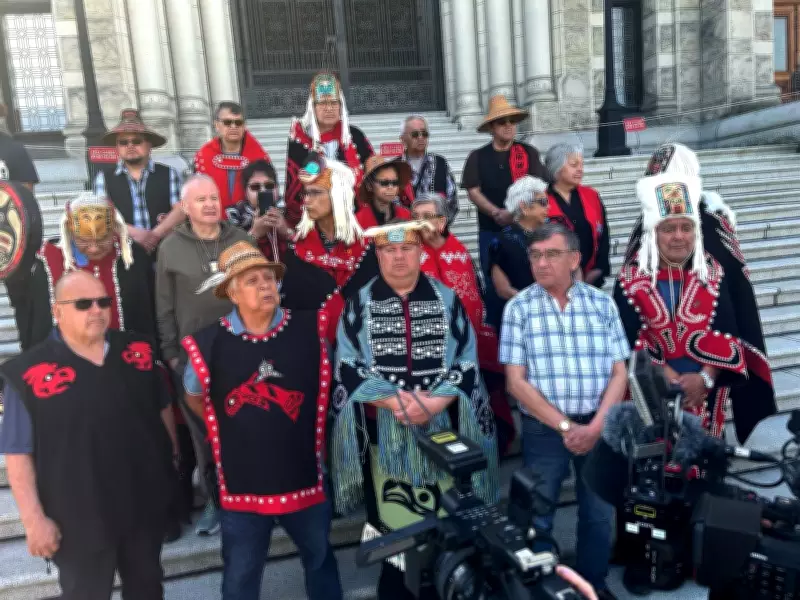
Overlapping Territorial Claims Fuel First Nations Protests Against B.C. Treaties
Representatives from multiple First Nations gathered at the British Columbia legislature in Victoria on Monday, April 20, 2026, to voice strong opposition to two proposed treaties, citing significant overlapping territorial claims as the primary concern. The demonstration involved members of the Nine Allied Tribes and the Lax Kw'alaams Band near Terrace, B.C., along with representatives from the Wei Wai Kum First Nation on Vancouver Island.
Core Issue: Unresolved Overlapping Claims
The protests center on what First Nations leaders describe as unaddressed overlapping claims between their traditional territories. These overlapping areas create complex jurisdictional and resource-rights conflicts that the proposed treaties allegedly fail to resolve adequately. The demonstrators argue that proceeding with the treaties without properly addressing these overlaps would undermine their sovereignty and rights to land and resources.
"Our territories have been shared and overlapping since time immemorial," stated one representative from the Nine Allied Tribes. "Any treaty that ignores this reality is fundamentally flawed and unacceptable to our communities."

Historical Context and Modern Implications
Overlapping claims are a longstanding issue in British Columbia, stemming from historical Indigenous land use patterns that did not conform to modern political boundaries. The current treaty process, which aims to establish formal agreements between First Nations and the provincial and federal governments, has struggled to navigate these complexities. The protesting groups emphasize that treaties must recognize and incorporate traditional governance structures and territorial relationships.
The Lax Kw'alaams Band, located near Terrace, and the Wei Wai Kum First Nation on Vancouver Island have both highlighted specific areas where their claims intersect with those of neighboring nations. These overlaps involve critical resources such as fisheries, forestry, and mineral rights, making resolution essential for economic stability and cultural preservation.
Political Response and Next Steps
The protest at the legislature signals escalating tensions as treaty negotiations advance. First Nations leaders are calling for a pause in the process to allow for comprehensive discussions on overlapping claims. They advocate for a collaborative approach that includes all affected nations in dialogue, rather than bilateral agreements that may exclude key stakeholders.
British Columbia's government has acknowledged the protests but has not yet committed to halting the treaty process. A spokesperson noted that overlapping claims are a recognized challenge in treaty-making and that efforts are underway to address them through existing frameworks. However, demonstrators remain skeptical, demanding more transparent and inclusive negotiations.
Broader Impact on Indigenous Rights
This situation underscores broader issues in Indigenous rights and reconciliation in Canada. Overlapping claims are not unique to British Columbia, but the intensity of the protests highlights the urgent need for innovative solutions. Experts suggest that successful treaty-making must balance legal precision with cultural sensitivity, ensuring that agreements reflect the dynamic and interconnected nature of Indigenous territories.
The outcome of this dispute could set a precedent for future treaties across the province and beyond. As First Nations continue to assert their rights, the pressure on governments to develop more equitable and inclusive processes is likely to increase. The protests serve as a reminder that true reconciliation requires addressing historical complexities with respect and collaboration.