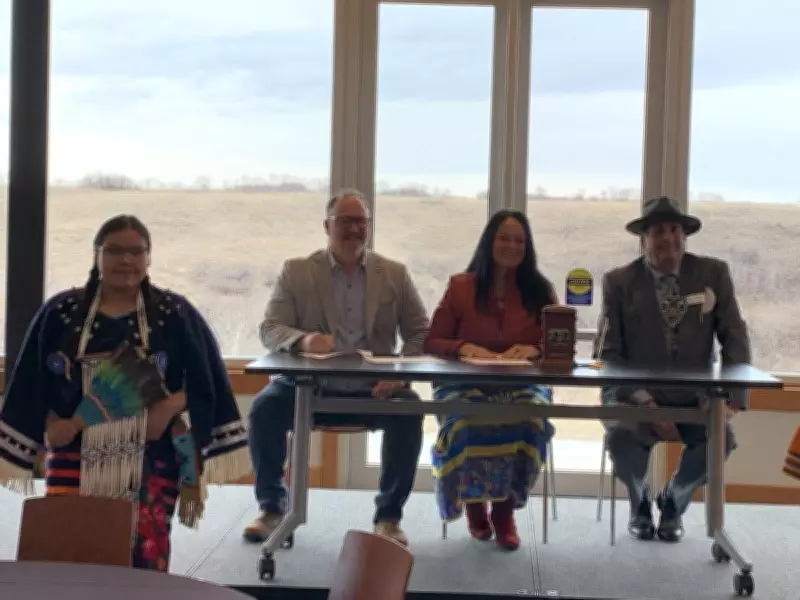
Wanuskewin Heritage Park has long served as a gathering place for Indigenous Peoples, and now future generations will continue to experience land-based learning at this cultural site north of Saskatoon. On Earth Day, Greater Saskatoon Catholic Schools (GSCS) renewed a nitōhtem (Cree for 'my friend') memorandum of understanding (MOU) with the park in front of students at Wanuskewin.
Goals of the Agreement
Kelley Cardinal, GSCS superintendent, emphasized the importance of the renewed partnership. 'The goal would be to ensure that students can develop their own tools and strategies for strengthening their identities and for creating that sense of belonging as a community,' she said.
According to the National Centre for Collaboration in Indigenous Education, land-based learning is defined as 'education, community and skills building or training that takes place outdoors in particular places of local significance, often on traditional Indigenous territories,' with Elders and Knowledge Keepers serving as teachers.

Program Details
As a result of the MOU, students can access hands-on programming, cultural dance teachings, and creative projects that take learning outside the classroom and onto the land. The park offers a medicine wheel, interactive games, a gift shop with Indigenous crafts, seven kilometres of walking trails, and a restaurant serving bison and bannock.
Cardinal noted that learning about the history of the bison and fossilized objects is valuable. Although land-based learning may be new to Saskatchewan, it has been practiced for many years. St. Michael Community School, St. Mary's Wellness and Education Centre, and Awâsisak kâ-nîmîhtocik (St. Francis School) have been part of a pilot program since last year, with more schools to be added in the coming years.
Community Perspectives
Cornelia Laliberte, GSCS partnership facilitator, described the agreement as a step toward 'removing social, developmental and systemic barriers,' allowing students to experience education in a meaningful way. GSCS board chair Diane Boyko highlighted the trust built through the partnership. 'You came here to learn, and learning is relational, and it's experiential, and it's deeply rooted in identity. We are connecting science and ancestral technology, history, language, culture, and ways that strengthen not only what you know, but who you are as peace, and who you are as a human family,' she said.
Andrew McDonald, co-executive director of Wanuskewin, emphasized that the MOU is more than just a formal agreement. 'It is about stepping into the land and learning through it,' while hearing 'directly from elders and knowledge keepers.'