Father Raymond J. de Souza, a prominent Christian voice, has posed a provocative question about public safety priorities in Canada: Would Jewish communities be better protected if they told police their synagogues were abortion clinics? His critique, published on January 7, 2026, highlights a stark contrast in police enforcement that has left many Canadian Jews feeling vulnerable.
A Tale of Two Responses
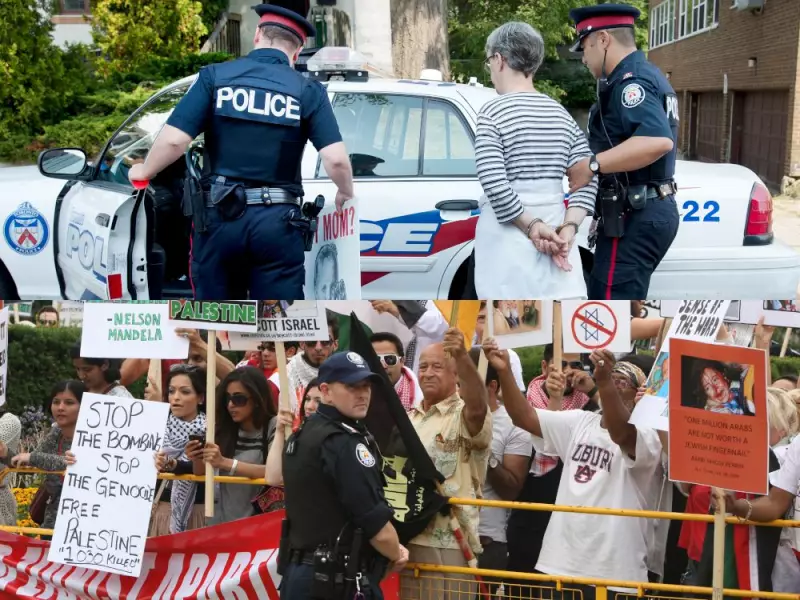
The article juxtaposes two images of Toronto police conduct. In one, officers are seen arresting a woman for a silent, solitary protest outside an abortion clinic. In another, they stand by passively as protesters display overtly anti-Jewish and anti-Israel slogans. This visual contrast underpins de Souza's central argument: Canada is vigilant about ensuring the serene operation of abortion clinics but somnolent about safety at Jewish institutions.
De Souza notes his solidarity with Jewish leaders amid rising antisemitism, emphasizing the intimidation faced by Jews in their daily lives. He references Shopify president Harley Finkelstein's recent account of such targeting, stating that despite years of awareness, police have been "allergic to any enforcement" of laws that could offer relief.
Police Conduct and Community Frustration
The critique focuses sharply on the Toronto Police Service. De Souza describes instances where police have chaperoned small, often masked groups shouting antisemitic slogans through Jewish neighbourhoods, watched as streets were blocked, and restricted pro-Jewish demonstrators. He suggests many rank-and-file officers are likely embarrassed by this inadequate response.
The piece points to what it calls a telling example of misplaced priorities. The day after the Hanukkah massacre in Sydney, Toronto police, perhaps aware of their inaction, charged a 62-year-old beekeeper for an alleged offence—distributing antisemitic flyers—that had occurred nearly a year earlier, on January 2, 2025. De Souza wryly notes the Jewish community would likely tolerate a "solitary beekeeping crank" if police would instead address the "masked mayhem" on their streets.
The Legal Disparity in Protection
The article details the stringent protections afforded to abortion clinics under Ontario's "bubble zone" legislation. It states that even a lone, silent individual wearing a t-shirt with a message like "I support Norway's abortion laws" within the buffer zone could be arrested, as it might be construed as an act of disapproval. It recalls a 2018 case in Ottawa where an octogenarian pro-life demonstrator was arrested for silently holding signs about free speech near a clinic.
This robust enforcement framework stands in sharp relief to the perceived lack of action against harassment targeting Jewish communities. De Souza concludes that the disparity raises profound questions about equality under the law and the state's duty to protect all citizens from intimidation, regardless of their faith or the political sensitivities surrounding the spaces they frequent.