Inside Alberta RCMP's High-Stakes Training Exercises
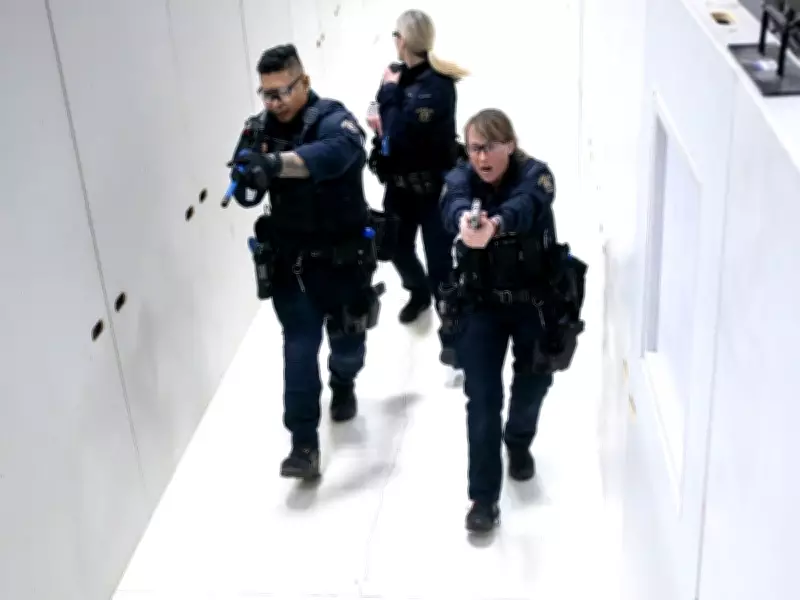
At the RCMP K-Division Training Centre located within the Edmonton International Airport's industrial zone, a controlled chaos unfolds as officers and invited officials participate in realistic scenarios that mirror the life-and-death decisions police face daily. The training facility becomes a crucible where threat assessment, de-escalation techniques, and use-of-force protocols are tested under pressure.
The Taser Experience: More Complex Than It Appears
During a recent training session, Leduc Mayor Lars Hansen discovered firsthand the complexities of police weaponry when he fired a Taser at an immobilized cardboard suspect. The demonstration revealed how the electrical weapon's near-transparent strands snake out from tiny hooks that latch through clothing, yet the suspect doesn't immediately fall—a reality that underscores the nuanced nature of police tools.
"It's a lot harder than it looks—there's a field of force in the gun in your hand," observed one participant, capturing the psychological and physical dimensions of police decision-making. A volunteer who actually received a Taser jolt to the back described the immediate bee-sting sensation of hooks digging in, followed by involuntary muscle contractions that caused him to fall and jerk uncontrollably.

Minimal Force Statistics and Threat Assessment Philosophy
RCMP Sergeant Dean Grunow, officer in charge of the K-Division Training Branch, emphasized that fewer than one percent of all RCMP officer public encounters actually result in the use of force. "It's important our members are able to effectively diagnose what they're dealing with and identify threat cues and risk elements that present themselves," Grunow explained.
"We don't want our members forcing the situation to turn into something violent when we could have prevented it," he added, highlighting the RCMP's commitment to de-escalation as a primary strategy.
Active Shooter Scenario: Every Officer's Nightmare
From an overhead scaffolding catwalk, elected officials watched an active shooter scenario unfold—a gun-wielding suspect pacing a small room in raging agitation while a motionless body lay in a pool of imagined blood on the floor. This scenario represents what Grunow described as "every Mountie's nightmare"—a situation where the bodily harm threshold has been met and immediate response is required.
When an officer bursts into the room with firearm drawn to neutralize the threat, participants understood that such actions would inevitably trigger scrutiny from the Alberta Serious Incident Response Team (ASIRT), adding another layer of complexity to split-second decisions.
De-escalation in Action: From Knife-Wielding to Submission
Another training exercise simulated a suspicious vehicle stop where a clearly agitated driver thumped his pickup in frustration, raging at police while waving a knife. As the scenario progressed, the driver tossed away the knife but continued advancing with fists brandished—demonstrating that weapon disposal doesn't necessarily complete de-escalation.
When officers deployed a Taser in this roleplay, the suspect quickly crumpled, thrashing weakly in the grips of the electrical current before submission ensued. Under Alberta's Mental Health Act, such a suspect would subsequently be evaluated to determine what caused the behavioral escalation.
The Psychological Weight of Police Work
The training exercises reveal the immense psychological burden carried by law enforcement officers who must constantly assess threat levels while knowing their decisions will face intense public and institutional scrutiny. Each scenario at the Edmonton International Airport facility reinforces that police work involves navigating a continuum of force where communication and assessment skills prove as crucial as tactical proficiency.
As participants experienced through hands-on demonstrations, the gap between training simulations and real-world encounters remains vast, yet these exercises provide essential preparation for the complex judgment calls that define modern policing in Alberta.