While Quebec accounted for a minuscule fraction of the finished fentanyl seized in a major national enforcement operation, the province was the epicentre for the seizure of chemicals used to manufacture the deadly opioid and other illicit drugs.
National Operation Yields Stark Provincial Breakdown
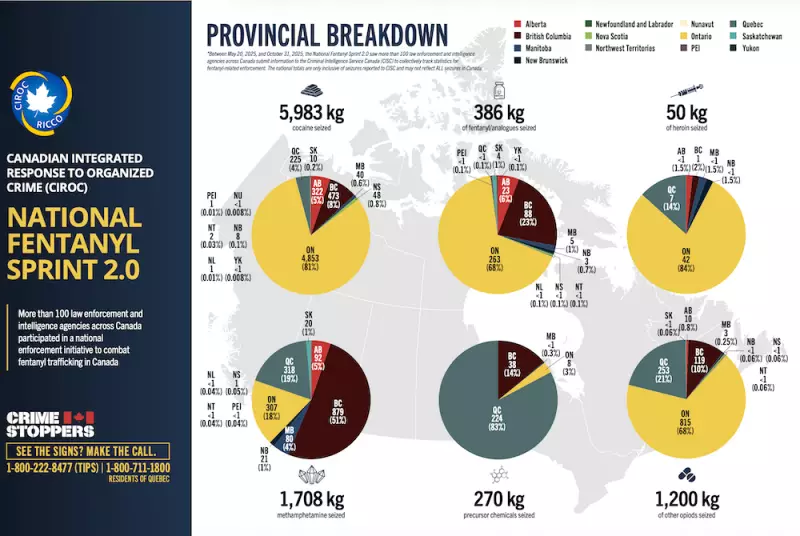
The results of National Fentanyl Sprint 2.0 were unveiled on Tuesday, detailing a coordinated crackdown that ran from May to October of this year. The initiative, led by the Canadian Integrated Response to Organized Crime (CIROC), involved over 100 law enforcement and intelligence agencies across the country.
Nationally, authorities seized a staggering 386 kilograms of fentanyl. However, the distribution was highly uneven. Ontario led with 68 per cent of the total fentanyl seized, followed by British Columbia at 23 per cent and Alberta at six per cent. In stark contrast, Quebec accounted for just 0.01 per cent of the fentanyl haul.

Quebec's Dominance in Precursor Chemical Seizures
The story shifts dramatically when examining the seizure of precursor chemicals—the substances used to synthesize drugs like fentanyl, methamphetamine, and MDMA. Of the 270 kilograms of these chemicals seized nationwide, an overwhelming 83 per cent was intercepted in Quebec.
The province also accounted for significant portions of other seized substances:
- 21 per cent of other opioids
- 19 per cent of methamphetamine
- 14 per cent of heroin
- 4 per cent of cocaine
Benoît Dubé, director deputy general of the Sûreté du Québec and CIROC's co-chair, acknowledged the issue. "We had the most ... but we have people in place working on that," he stated, noting a recent MDMA lab dismantlement in Mont Tremblant and a dedicated provincial task force.
Targeting the Supply Chain and Organized Crime
Officials emphasized that the seizures point to sophisticated, large-scale criminal operations. Dan Anson, director general of intelligence and investigations at the Canada Border Services Agency (CBSA), explained that precursor chemicals largely originate from China and enter Canada primarily through West Coast ports, eventually reaching major metropolitan areas like Vancouver, Toronto, and Montreal.
"The seizures point to large-scale, organized criminal operations," Anson said. The CBSA's focus is on supporting police to block these chemicals at the border, thereby reducing domestic drug production and overdose deaths, and preventing Canada from becoming a fentanyl exporter.
Ken Lamontagne, director general of Criminal Intelligence Service Canada, confirmed the domestic nature of the crisis: "It's certainly not for an export-based market when it comes to fentanyl."
The sweeping operation, which executed 1,068 search warrants, also resulted in 217 arrests for trafficking fentanyl while on bail and the seizure of $13.46 million in cash. Due to the success of the fentanyl sprints, RCMP Assistant Commissioner Bonnie Ferguson announced that the focused work on fentanyl and opioids will continue under a new formalized structure.