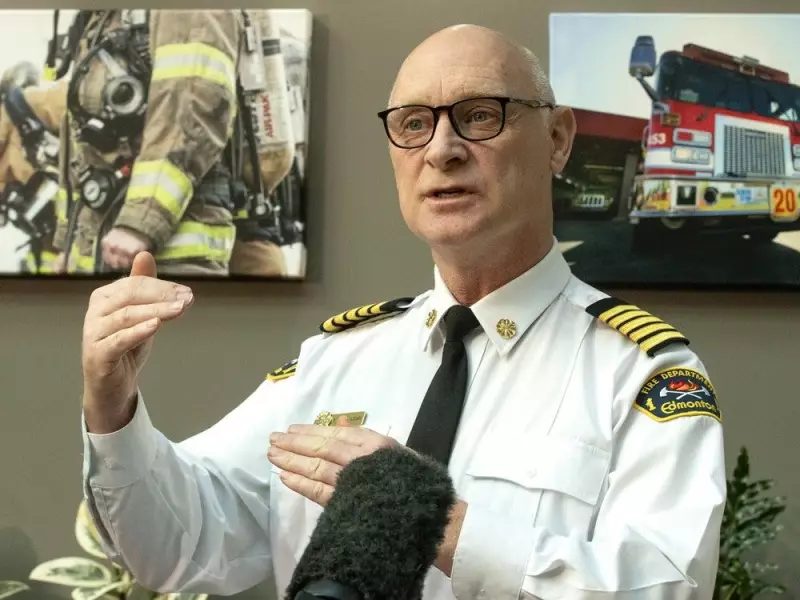
Edmonton Fire Chief Urges Six New Stations Amid Population Surge
Edmonton Fire Rescue Services Chief David Lazenby has issued a stark warning about the city's emergency response capabilities following unprecedented population growth. During a recent news conference reviewing 2025 operations and planning for 2026, Lazenby emphasized that Edmonton must budget for six new fire stations within the next four years to maintain critical response standards.
Growing Demands Require Immediate Action
The fire chief's urgent call comes as Edmonton experiences record-breaking emergency call volumes and rapid residential development beyond Anthony Henday Drive. EFRS responded to 91,000 emergency incidents in 2025 alone, involving more than 166,000 apparatus runs. This represents a staggering 68 percent increase in annual call volume over the past five years.
"This is a year where we try and address the realities of a growing city and try and ensure that we serve Edmontonians equally," Lazenby stated during his presentation. The chief explained that without immediate infrastructure investment, response times will inevitably suffer in rapidly expanding neighborhoods.

Targeted Areas for New Stations
Six specific communities have been identified as priority locations for new fire stations:
- Big Lake
- Riverview
- Wedgwood
- Chappelle
- Cumberland
- Horse Hills
These areas are expected to see continued development influx, with projections indicating approximately 120,000 residents will inhabit these six neighborhoods by 2030. "Based on current population and projected population to 2030, we feel that we ideally need six additional stations to serve that rapidly growing population," Lazenby explained.
Infrastructure Challenges and Costs
The proposed stations represent just one aspect of Edmonton's emergency infrastructure needs. Lazenby also highlighted the challenge of replacing aging fire apparatus, noting that firefighting equipment costs have doubled in recent years due to inflation, pandemic-era slowdowns, and potential tariffs.
"Fire apparatus have doubled in cost in the last few years, which is creating significant challenges for municipalities across North America," the chief acknowledged. The most recent station addition was Blatchford, which opened in 2025 at a cost of at least $29 million, replacing two older stations.
Response Time Concerns
Current station locations create problematic response times for the city's expanding perimeter communities. "Because of where the existing stations are, it's a long response time there. We want to make sure we've got the resources in place," Lazenby emphasized.
The chief framed the population growth in dramatic terms, noting that fitting emergency infrastructure into Edmonton's residential expansion is equivalent to adding an entire city the size of Red Deer to the municipality's service area.
National Context and Local Challenges
During his presentation, Lazenby revealed that Edmonton's downtown Station No. 1 ranks among Canada's busiest fire stations, likely second only to an East Vancouver location in terms of demand. "That's the scale of Canada's demand, in Edmonton's downtown," he remarked while reviewing 2025 statistics.
The chief also highlighted unique Edmonton challenges, including extreme winter conditions and complex social factors. He recalled a powerful social media image showing an Edmonton firefighter covered in icicles after battling a blaze for hours in sub-zero temperatures.
"The demands of the business are the same, no matter where you are, but the extra variants that are unique to Edmonton, the social challenges, the climate, make our folks just that little bit extra-special," Lazenby concluded, underscoring both the challenges and dedication of Edmonton's firefighting personnel.