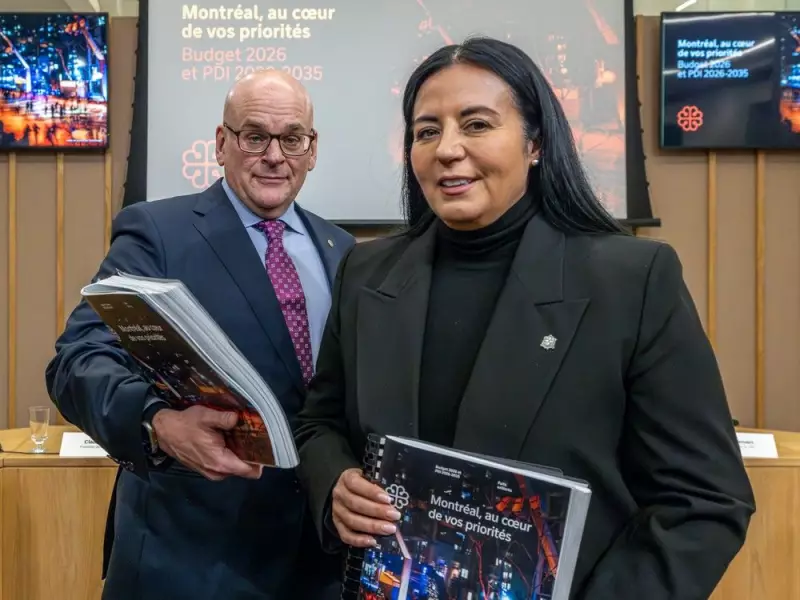
Montreal Mayor Soraya Martinez Ferrada has unveiled her administration's inaugural budget, a record $7.67 billion financial plan that seeks to steer the city toward calmer fiscal waters while delivering on key campaign promises. Presented alongside Executive Committee Chair Claude Pinard at City Hall on Monday, January 12, 2026, the budget represents the new mayor's first major test in aligning her electoral commitments with the stark realities of governing Canada's second-largest city.
A Budget of "Rigorous and Responsible" Choices
"This is a big moment because this is our first budget and it's the one everyone waits for," Mayor Martinez Ferrada stated. "We know expectations are high. A budget isn't just about numbers; it's about choices. And today we're delivering on what we promised." The mayor emphasized that the spending plan reflects "rigorous and responsible" decisions aimed at serving the interests of all Montrealers.
The administration inherited a challenging financial landscape, including a heavy reliance on property taxes, provincial funding constraints, inflation, rising debt costs, and seven upcoming public-sector union negotiations. Despite criticizing the $2 billion spending increase over eight years under former mayor Valérie Plante, Martinez Ferrada's own budget marks a 5.4% jump from the previous year.

Tackling Debt and the Property Tax Reality
A cornerstone of the new fiscal plan is addressing the city's debt. The administration has committed to returning Montreal's debt-to-revenue ratio to 100% in 2026, a year ahead of the previous schedule. "The credit card of the city was maxed out — actually over the limit," Martinez Ferrada explained. "Bringing Montreal's debt ratio to 100%... signals credibility. It's important for the future of the city." Debt servicing charges alone have risen by $87 million this year, now consuming 16.6% of the budget.
To fund city operations, residential and commercial property taxes will rise by an average of 3.4%. When combined with borough-level increases, the effective hike for homeowners is closer to 3.8%, adding roughly $188 to the average tax bill in 2026. The administration defends this increase as being in line with its campaign promise, using the inflation rate from September 2024 to September 2025 as its benchmark. Property taxes still account for 62.7% of municipal revenues.
Executive Committee Chair Claude Pinard revealed the tight constraints faced by the city, noting that only 3.2% of the $400-million operating budget increase was discretionary. "We have zero room to manoeuvre," Pinard admitted, calling the lack of financial flexibility one of the surprises of taking office.
Funding Priorities: Homelessness, Security, and Core Services
The budget directs significant new resources toward the mayor's stated priorities for her first 100 days. Most notably, funding for community groups combating homelessness will be tripled to nearly $30 million. The city also plans investments exceeding $100 million over the next decade for additional shelters. A new protocol for homeless encampments aims to make them safer and more humane, supported by bolstered tactical intervention teams that pair police officers with social workers.
Other key allocations focus on public security and cleanliness, while also continuing investments in green space acquisition, school zone safety, new cycling paths, and climate adaptation—initiatives reminiscent of the previous Plante administration.
The mayor's pledge to cut 1,000 positions from the municipal workforce remains a work in progress, with more details expected later in the year. The current budget identifies recurrent savings of $79 million, just over one percent of the total.
With this first budget, Mayor Soraya Martinez Ferrada and her team have laid down their financial marker. The plan attempts to balance the immediate need to stabilize the city's books with targeted investments in urgent social issues, setting the course for the administration's term as Montreal navigates its post-pandemic recovery.